

You are staring at a small glass vial filled with aquarium water. The color chart in your hand says a safe tank should test at zero parts per million, which is a bright, clear yellow. But the liquid in your vial looks just a little bit green. It looks exactly like the 0.25 ppm mark.
If you are new to keeping fish, this is usually the moment panic sets in. You might be doing daily water changes to fix it. You might be wondering why your tank refuses to finish cycling. You might even be worried that your local fish store gave you bad advice.
Take a deep breath. The API Freshwater Master Test Kit is a fantastic tool for beginners. It is accurate, affordable, and essential for understanding your water chemistry. However, that persistent 0.25 ammonia reading is incredibly common. In many established tanks, it is completely fake.
Let us look at why this false positive happens and how you can figure out if your fish are actually in danger.
The Chemistry Behind the Green Tint
To understand why your test kit is lying to you, you need to know how it works. The API ammonia test uses a two-part liquid chemical reaction. When you add those drops to your water, the chemicals react with any ammonia present and turn the water green. The more ammonia you have, the darker the green becomes.
But sometimes, a true zero still looks slightly green. There are two main reasons for this.
First, lighting plays a massive role in how we perceive color. Indoor lighting, especially warm yellow bulbs or harsh fluorescent tubes, casts shadows through the round glass vial. The chemicals themselves have a slight tint. When you hold a round vial against a flat white card under bad lighting, a pure yellow zero can easily look like a pale green 0.25.
Second, your tap water might be tricking the test. Many city water treatment plants use chloramine to keep drinking water safe. Chloramine is simply chlorine bonded to ammonia. When you add a good water conditioner to your tap water, it breaks that bond. It neutralizes the chlorine and binds the ammonia into a safe, non-toxic form that your biological filter will eventually consume.
The problem is that the API test kit measures total ammonia. It cannot tell the difference between toxic free ammonia and the safe, bound ammonia your water conditioner just created. If your tap water has chloramines, your test kit will almost always show a slight reading right after a water change.

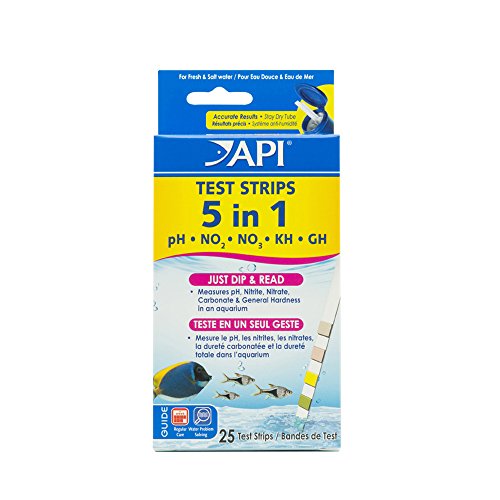
API 5-in-1 Aquarium Test Strips - 25 Count
Check Price on AmazonHow to Find Your True Zero
If you want to stop guessing, you need to establish a baseline. You need to see exactly what a true zero looks like under your specific house lighting.
Here is a simple way to find your true zero:
- Get pure water: Buy a jug of distilled water or use bottled spring water. Do not use your tap water for this test.
- Run the test: Fill a clean test vial to the 5ml line with the pure water. Add eight drops from ammonia bottle number one. Add eight drops from ammonia bottle number two. Cap it and shake vigorously.
- Wait five minutes: The color needs time to develop fully.
- Compare the vials: Run a second test using your aquarium water at the same time. Hold both vials side by side against the white area of your color chart.
If the vial with the distilled water looks exactly the same color as the vial with your tank water, congratulations. Your tank is at zero. Your eyes are just picking up the natural tint of the test chemicals. Memorize that specific shade of yellowish-green. That is your new zero.
Diagnosing Your Tank
Sometimes, you do not have distilled water handy. You can usually figure out if your 0.25 reading is real by looking at the rest of your tank parameters. Use this chart to diagnose your specific situation.
| Your Tank Conditions | Likely Meaning | Action to Take |
|---|---|---|
| Tank is over 3 months old. Nitrites are 0. Nitrates are showing. Fish are active and eating. | False Positive. Your biological filter is fully established. | Relax. Keep up with your normal weekly maintenance schedule. |
| Tank is under 6 weeks old. Nitrites are above 0. | Real Ammonia. Your tank is still actively cycling. | Do a 25% water change. Dose a water conditioner that binds ammonia. Test again tomorrow. |
| Tap water tests at 0.25. Tank water tests at 0.25. | Chloramines in Tap Water. The test is reading safe, bound ammonia. | Ensure you are using a high-quality water conditioner. Monitor fish behavior. |
| Fish are gasping at the surface. Gills look red. Water is suddenly cloudy. | Real Ammonia Spike. Something has disrupted your biological filter. | Perform an immediate 30% water change. Check for dead fish or rotting food. |
When the Ammonia is Real
While false positives are common, you should never ignore a green vial completely. There are specific times when that 0.25 reading is absolutely real and requires your attention.
If you just set up a 10-gallon starter kit last week and added fish, your cycle is just beginning. The beneficial bacteria that eat ammonia have not grown yet. In a brand new tank, any green tint is real ammonia building up from fish waste. You will need to perform frequent partial water changes to keep your fish safe while the bacteria catch up.
Real ammonia spikes also happen when we make mistakes. Overfeeding is the most common culprit. If you dump too many flakes into the water, the uneaten food sinks to the gravel and rots. As it decays, it produces ammonia. A missing fish or a dead snail decaying inside your filter will cause the exact same problem.
If you determine the ammonia is real, do not panic. Do a 30 percent water change using temperature-matched, conditioned tap water. Use a gravel vacuum to clean up any rotting debris on the bottom of the tank. Test the water again the next day to make sure the levels are dropping.
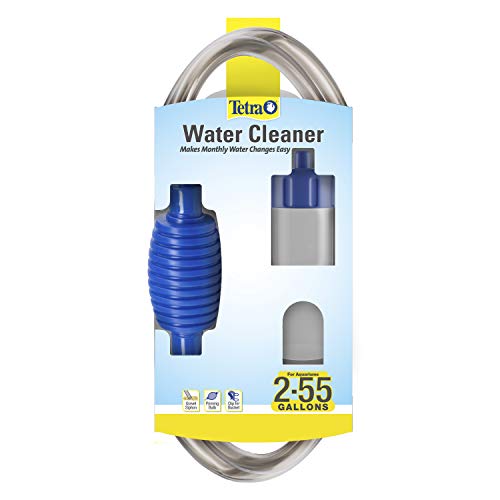
Tetra Gravel Siphon for Aquariums
Check Price on AmazonKeep Testing Your Water
Testing your water is the best habit you can build in this hobby. It is the only way to know what is happening beneath the surface of your aquarium.
Do not let a confusing color chart frustrate you. Once you test some distilled water and find your true zero, you will know exactly what to look for. You will be able to spot a real ammonia spike before it harms your fish, and you will be able to enjoy your tank without constantly worrying about a harmless green tint.


