

Quick Answer
Yellow Lab cichlids (Labidochromis caeruleus) are the most peaceful Mbuna species and an excellent entry point into African cichlid keeping. They need a minimum 30-gallon tank with rocky caves, alkaline water (pH 7.2-8.8), and — counterintuitively — a well-stocked tank to prevent aggression.
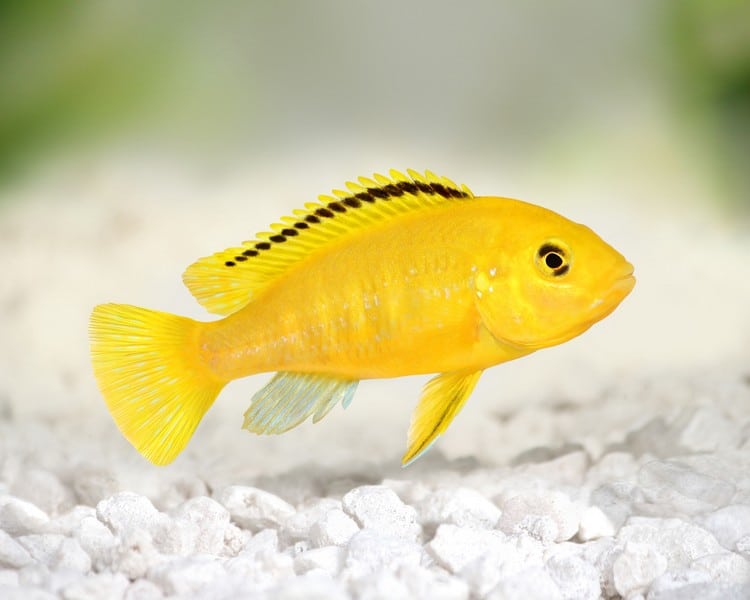
Most people get into Mbuna because they want marine-level color without the marine-level complexity. The Yellow Lab delivers exactly that — electric yellow bodies with jet-black dorsal striping that rivals anything from a reef tank. But here’s what the pet store won’t tell you: these fish are peaceful until you understock them.
I’ve kept Labs for over a decade, and the single biggest mistake I see is hobbyists buying three or four fish “to start small.” That’s backwards. A sparse Yellow Lab tank is an aggressive Yellow Lab tank. We’ll get into why — and what to do about it — below.

Quick Care Overview
Scientific Name: Labidochromis caeruleus
Adult Size: 4 inches (10 cm)
Lifespan: 6-10 years
Minimum Tank: 30 gallons
Temperature: 71-82°F (22-28°C)
pH: 7.2-8.8
Hardness: 10-20 dGH
Temperament: Peaceful for Mbuna
Diet: Omnivore (insectivore-leaning)
Breeding: Mouthbrooder
What Makes Yellow Labs Different From Other Mbuna
Labidochromis caeruleus goes by many names — Electric Yellow Cichlid, Lemon Drop Cichlid, Yellow Prince, Blue Streak Hap — but the important distinction is behavioral, not cosmetic. Most Mbuna species are territorial nightmares that require careful stocking to prevent murder. Yellow Labs are genuinely mild-mannered.
The reason is diet. In Lake Malawi, most Mbuna are aggressive aufwuchs grazers defending their algae patches. Yellow Labs are primarily insectivores that pick invertebrates from rock crevices. Less territorial feeding behavior means less territorial aggression overall.
That said, “peaceful for Mbuna” still means “more aggressive than your average community fish.” Don’t mix these with tetras.
Color Variants by Collection Point
The “yellow” in Yellow Lab is actually a regional variant. Wild populations show dramatically different coloration depending on where in Lake Malawi they originate:
- Lion’s Cove: Classic bright yellow with whitish belly — the standard aquarium form
- Kakusa: Yellow body with blue dorsal fin
- Lundu Island: White body
- Undu Point: White with dark blue dorsal stripe
- Nkhata Bay: White body with blue fins
Nearly all Yellow Labs in the hobby are now captive-bred, primarily in the Czech Republic and Singapore. Czech-bred fish are smaller, more expensive, and generally higher quality. Singapore fish are cheaper but have higher hybrid risk — watch for faint vertical barring on the body, which can indicate crossbreeding with other Labidochromis species.
Tank Setup
Size and Shape
Minimum 30 gallons for a species-only group. Go longer rather than taller — a 40-breeder footprint works better than a 40-tall. Horizontal swimming space lets subordinate fish escape dominant males without the aggression escalating.
[TIP] Pro Tip
The “one inch per gallon” rule doesn’t apply to Mbuna. Cichlid aggression is about territory, not bioload. A 55-gallon with 20 Yellow Labs will be more peaceful than a 55-gallon with 6, because no single fish can establish dominance when outnumbered.
Hardscape and Substrate
Rocky caves are non-negotiable. In Lake Malawi, these fish live in the rocky rubble zones, darting between crevices. Stack rocks to create multiple line-of-sight breaks and hiding spots. Each fish should have access to at least one cave or overhang.
For substrate, sand or fine gravel both work. Here’s the part most guides skip: substrate color affects fish color. Yellow Labs will pale noticeably over white coral sand or light-colored substrates. If you want that electric yellow to pop, use a darker substrate — black sand or dark gravel.
Plants are optional. Labs won’t destroy them like some Mbuna will, but Lake Malawi biotopes are typically plant-free. If you want greenery, stick with hardy species like Anubias or Java Fern attached to rocks.
Water Parameters
Lake Malawi is a rift lake — mineral-rich, alkaline, and hard. Your tap water might already be close to ideal if you’re in a limestone region.
- pH: 7.2-8.8 (higher is fine; lower is stressful)
- Hardness: 10-20 dGH
- Temperature: 71-82°F
- Ammonia/Nitrite: 0 ppm (always)
- Nitrate: Below 40 ppm
Lake Malawi has no tides or currents, but Yellow Labs appreciate moderate water movement. Run a canister filter rated for at least 1.5x your tank volume, and consider adding a powerhead or airstone for extra oxygenation.
Weekly water changes of 10-20% keep nitrates in check. These fish are sensitive to poor water quality — flashing against substrate, loss of appetite, and surface gasping are all signs your parameters have slipped.
Lighting
Low to medium intensity. In their natural habitat, light is diffused by rock formations. Bright lighting won’t harm them, but it can wash out their coloration and promote algae growth on your hardscape.
Diet
Yellow Labs are omnivores that lean insectivore. This is actually good news — they’re less prone to Malawi bloat than strictly herbivorous Mbuna because their digestive systems handle protein better.
A solid staple diet includes:
- High-quality cichlid pellets or flakes
- Spirulina-based foods (enhances yellow coloration)
- Frozen foods: Mysis shrimp, bloodworms, brine shrimp
Avoid feeding mammalian proteins (beef heart, etc.) — these are hard on cichlid digestive systems. Goldfish food works in a pinch but shouldn’t be a staple.
Feed once or twice daily, only what they can consume in 2-3 minutes. Overfeeding fouls water quality fast in a well-stocked Mbuna tank.
Common Health Issues
[WARNING] The Real Cause of Most Mbuna Deaths
Poor water quality causes more Yellow Lab deaths than any specific disease. Before treating for anything, test your parameters. High ammonia or nitrite will kill fish faster than most pathogens.
Malawi Bloat
The dreaded Mbuna killer. Symptoms include swollen abdomen, loss of appetite, and lethargy. Despite the name, this isn’t always diet-related — stress, poor water quality, and internal parasites all contribute.
Treatment: 30% water change immediately, then treat with Metronidazole. Prevention is better — maintain water quality, avoid overfeeding, and include vegetable matter in the diet even though Labs are more insectivore-leaning than other Mbuna.
Hole in the Head (HITH)
Caused by the Hexamita parasite. Starts with small pits or lesions along the lateral line and head, eventually spreading if untreated. Stress, overcrowding, and poor nutrition are contributing factors.
Quarantine affected fish and treat with Metronidazole. Address the underlying stressor or it will return.
Ich (White Spot Disease)
The classic white-dot parasite. Present in most aquariums but only attacks stressed or immunocompromised fish. Raise temperature to 86°F for three days and treat with a copper-based medication or ich-specific treatment.
Tank Mates
Yellow Labs do best with other Mbuna — that’s not just a suggestion, it’s the setup that produces the least aggression. A species-only tank of 15-20 individuals is peaceful and visually striking.
For a mixed Mbuna community, choose species that won’t hybridize easily and aren’t hyper-aggressive:
- Good choices: Pseudotropheus acei, Cynotilapia afra, Iodotropheus sprengerae (Rusty Cichlid)
- Avoid: Melanochromis auratus (extremely aggressive), any species that looks similar to Yellow Labs (triggers territorial behavior and hybridization risk)
A mix of yellow, blue, orange, and black Mbuna creates a reef-like visual without the reef-level maintenance. Just be aware that Labidochromis can hybridize with Pseudotropheus and Metriaclima if given the opportunity — serious breeders keep them separate.
[FACT] An understocked Yellow Lab tank (fewer than 12-15 fish) is typically more aggressive than a well-stocked one. When no single fish can establish dominance, aggression gets distributed and minimized.
Breeding Yellow Labs
Yellow Labs breed readily in captivity. If you have males and females in good condition, spawning is almost inevitable.
Sexing
Sexing Yellow Labs isn’t straightforward, especially in juveniles. General guidelines:
- Males: Deeper yellow coloration overall, including the belly. May show black chin, black outlining on finnage, and larger egg spots on the anal fin. Dominant fish in a group are almost always male.
- Females: Lighter belly (sometimes white), shorter fins, little to no black outlining. No black chin.
Aim for a ratio of 2-3 females per male to prevent any single female from being harassed to exhaustion.
Spawning Behavior
Males establish and defend a territory — usually a cleared patch of substrate or a flat rock surface. They display by shimmying and flaring at passing females while chasing off rival males.
During spawning, the female lays eggs one at a time, immediately picking each one up in her mouth. She then mouths the male’s egg spots, triggering him to release sperm. This fertilizes the eggs inside her mouth.
Yellow Labs are maternal mouthbrooders. The female holds the developing eggs and fry for approximately three weeks, during which time she won’t eat. After release, fry are fully formed and will immediately seek cover in rock crevices. They’re large enough to eat crushed flake from day one.
If you want to maximize fry survival, either move holding females to a separate tank or provide ample rockwork with small crevices where fry can hide from tank mates.
Frequently Asked Questions
Are Yellow Lab cichlids aggressive?
Yellow Labs are the most peaceful Mbuna species. However, they can become aggressive in understocked tanks where males can establish dominance. Keeping 15+ individuals typically prevents aggression by distributing territorial pressure.
How big do Yellow Lab cichlids get?
Adult Yellow Labs reach approximately 4 inches (10 cm). Males tend to be slightly larger and more elongated than females. In very large tanks with optimal conditions, some individuals may exceed this slightly.
Can Yellow Labs live with other fish?
Yellow Labs do best with other Mbuna cichlids from Lake Malawi. Avoid mixing with community fish like tetras or peaceful species that can’t handle Mbuna energy. Also avoid Melanochromis auratus and any species that looks similar to Yellow Labs to prevent hybridization.
Why is my Yellow Lab turning pale?
Light-colored substrates like white coral sand cause Yellow Labs to fade significantly. Switching to dark sand or gravel will bring out their electric yellow coloration. Stress, poor water quality, and illness can also cause color loss — check your parameters first.
How can I tell if my Yellow Lab is male or female?
Males typically show deeper yellow coloration overall (including belly), black outlining on fins, and sometimes a black chin. Females have lighter bellies (often white), shorter fins, and minimal black markings. Dominant juveniles in a group are almost always male.
Yellow Labs are the gateway Mbuna for a reason. They deliver the color impact of marine fish with freshwater simplicity, and they won’t terrorize your tank the way more aggressive cichlids will. Stock heavily, provide rocky caves, keep your water clean, and you’ll have a decade of electric yellow to enjoy. [INTERNAL LINK: “Mbuna species” -> Mbuna species guide] [INTERNAL LINK: “African cichlid” -> African cichlid care]


