
You glance at your tank and notice tiny white specks on your fish that weren’t there yesterday. By tomorrow, half your tank could be covered. Ich spreads fast, and every hour you wait makes treatment harder.
The good news: ich is completely treatable if you act quickly and understand how this parasite actually works.
Quick Answer
Treat ich by raising tank temperature to 86°F (30°C) and adding 1 tablespoon of aquarium salt per 5 gallons. Maintain treatment for at least 2 weeks after the last spot disappears, as the parasite has life stages you can’t see. For severe cases, use a malachite green or formalin-based medication.
What Is Ich (White Spot Disease)?
Ich is caused by the protozoan parasite Ichthyophthirius multifiliis. It burrows into your fish’s skin, feeds on tissue, then drops off to reproduce on the tank bottom — releasing hundreds of free-swimming parasites that seek new hosts.
This life cycle is why ich outbreaks escalate so quickly. One infected fish can seed an entire tank within days.
[FACT] The white spots you see are actually individual parasites feeding under your fish’s skin. Each spot can release 200-1,000 new parasites when it detaches.
If left untreated, ich damages gills and weakens fish to the point where secondary infections take over. It’s almost always fatal without intervention.
Identifying Ich
Several diseases cause white spots on fish. Here’s how to confirm you’re dealing with ich:
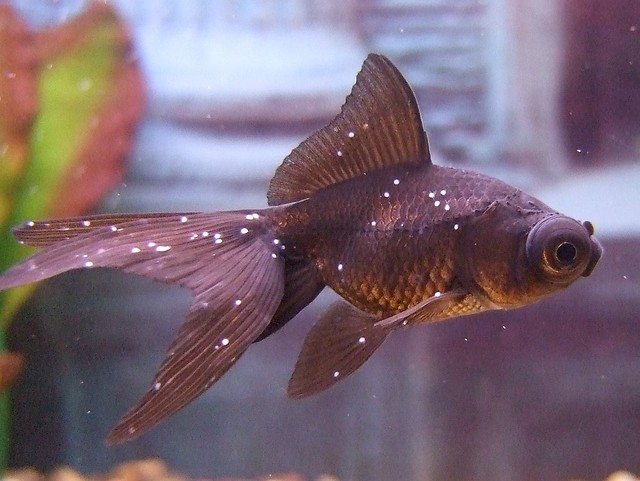
- Multiple small spots. Ich looks like grains of salt — tiny, white, slightly raised. If you see just one larger fuzzy spot, that’s likely fungus, not ich.
- Rapid spread. Ich transfers easily between fish. Seeing spots on multiple fish strongly suggests ich.
- Behavioral changes. Infected fish often “flash” (rub against surfaces), breathe rapidly, or become lethargic.
Treating Ich: Three Methods
Start treatment immediately — don’t wait to “see if it gets worse.” The visible spots are just one stage of the parasite’s life cycle. You need to kill it at all stages, which takes time.
[WARNING] Critical Timing
The white spots disappearing does NOT mean treatment worked. The parasite drops off fish to reproduce, then reattaches. Continue treatment for at least 2 weeks after you see the last spot.
Method 1: Heat Treatment
Raising tank temperature to 86°F (30°C) speeds up the parasite’s life cycle and can kill it outright. This is the gentlest method and works well for heat-tolerant species.
How to do it:
- Raise temperature gradually — no more than 2°F per hour
- Add extra aeration (air stone or surface agitation) since warm water holds less oxygen
- Maintain the high temperature for 10-14 days after the last visible spot
[TIP] Pro Tip
Not all fish tolerate 86°F. Most tropical community fish handle it fine, but check your specific species. Goldfish and white cloud minnows, for example, should not be treated with heat alone.

Method 2: Salt Treatment
Aquarium salt disrupts the parasite’s osmotic balance while most freshwater fish tolerate it well. This method works best combined with heat.
How to do it:
- Use pure aquarium salt or non-iodized salt with no anti-caking agents (NOT table salt)
- Dissolve 1 tablespoon per 5 gallons in a cup of tank water
- Add slowly over 1-2 hours, allowing fish to acclimate
- Replace proportional salt with each water change
[WARNING] Scaleless Fish
Loaches, catfish (including corydoras), and other scaleless fish are highly sensitive to salt. Use half the dose or choose medication instead.
Method 3: Medication
For severe outbreaks or when heat/salt aren’t working, use a commercial ich treatment. Most contain malachite green, formalin, or a combination.
Important considerations:
- Remove activated carbon from your filter — it absorbs medication
- Follow package directions exactly; overdosing harms fish
- Most medications are toxic to invertebrates (snails, shrimp) — move them to a separate container
- Continue treatment for the full duration, even after spots disappear
| Treatment | Best For | Avoid With | Duration |
|---|---|---|---|
| Heat (86°F) | Tropical fish, mild cases | Coldwater species | 10-14 days |
| Salt | Most community fish | Scaleless fish, plants | 10-14 days |
| Medication | Severe outbreaks | Invertebrates | Per package (usually 7-14 days) |
Preventing Future Outbreaks
Once you’ve cleared an ich outbreak, these practices dramatically reduce the chance of it happening again:
- Quarantine all new fish. Keep new arrivals in a separate tank for 2-4 weeks before adding them to your display tank. This alone prevents most disease introductions. [INTERNAL LINK: “quarantine tank setup” -> how to set up a quarantine tank]
- Maintain water quality. Stressed fish get sick. Test weekly with a liquid test kit, keep ammonia and nitrite at zero, and avoid overcrowding. [INTERNAL LINK: “nitrogen cycle” -> aquarium nitrogen cycle]
- Don’t cross-contaminate. Use separate nets and equipment for each tank. Never add pet store water to your aquarium.
- Observe before buying. Skip any fish from a tank that shows signs of disease, even if the fish you want looks healthy.
Frequently Asked Questions
How long does it take to cure ich?
Most ich treatments take 10-14 days from start to finish. The visible spots may disappear within a few days, but you must continue treatment to kill parasites in other life stages. At 86°F, the parasite completes its cycle in about 4 days; at lower temperatures, it takes longer.
Can ich kill fish?
Yes. Untreated ich is almost always fatal. The parasites damage gills (causing breathing problems), create open wounds that lead to secondary infections, and stress fish to the point of organ failure. Early treatment has a high success rate.
Can I treat ich with just heat, no salt or medication?
Sometimes. Sustained temperatures of 86°F (30°C) can eliminate ich on their own for mild cases in heat-tolerant fish. However, combining heat with salt is more reliable and still gentle. Use medication for stubborn or severe infections.
Is ich contagious to other tanks?
Not on its own — ich can’t travel between tanks without help. However, you can transfer it via shared equipment, nets, your hands, or adding water from an infected tank. Use dedicated tools for each aquarium during an outbreak.
Why do my fish keep getting ich?
Recurring ich usually means either treatment was stopped too early (parasites survived in life stages you couldn’t see) or ongoing stress is weakening fish immunity. Check water parameters, ensure proper tank size, and look for aggression or other stressors.
Have questions about treating ich or want to share what worked for you? Leave a comment below.
Cover photo: Ichthyophthiriose.JPG by Thomas Kaczmarczyk