

If you’re looking for a peaceful algae-eater to add to your community tank, you might want to consider a plecostomus (pleco). There are many different pleco types, all of which belong to the Loricariidae family, and all with different coloration and personalities, but the Rubber Lipped pleco is a good one to start with.
In this article, we provide you with all the information that you need about the Rubber Lip pleco, enabling you to be sure whether one of these fish would be suitable for your setup.
What is a Rubber Lip pleco
All plecos originate from South American rivers and lakes and can vary in size from a few inches to two feet long.
The Rubber Lipped pleco doesn’t grow as large as the Common pleco and can be a good choice if you want a smaller specimen that won’t outgrow your tank.
The Rubber Lipped pleco is a bottom-dwelling fish that’s a member of the Chaetostoma genus, which is part of the largest catfish family of suckermouth armored catfishes. Rubber Lip plecos are also known by other common names, including Striped, Blonde, or Bulldog pleco.
Bulldog plecs have enlarged gills that are thought to have evolved to enable the fish to breathe while they are feeding or attached to rocks and driftwood in their habitat.
Plecs are popular additions to many home aquariums because they are algae eaters, helping to keep the tank surfaces clean.
Mistaken identity
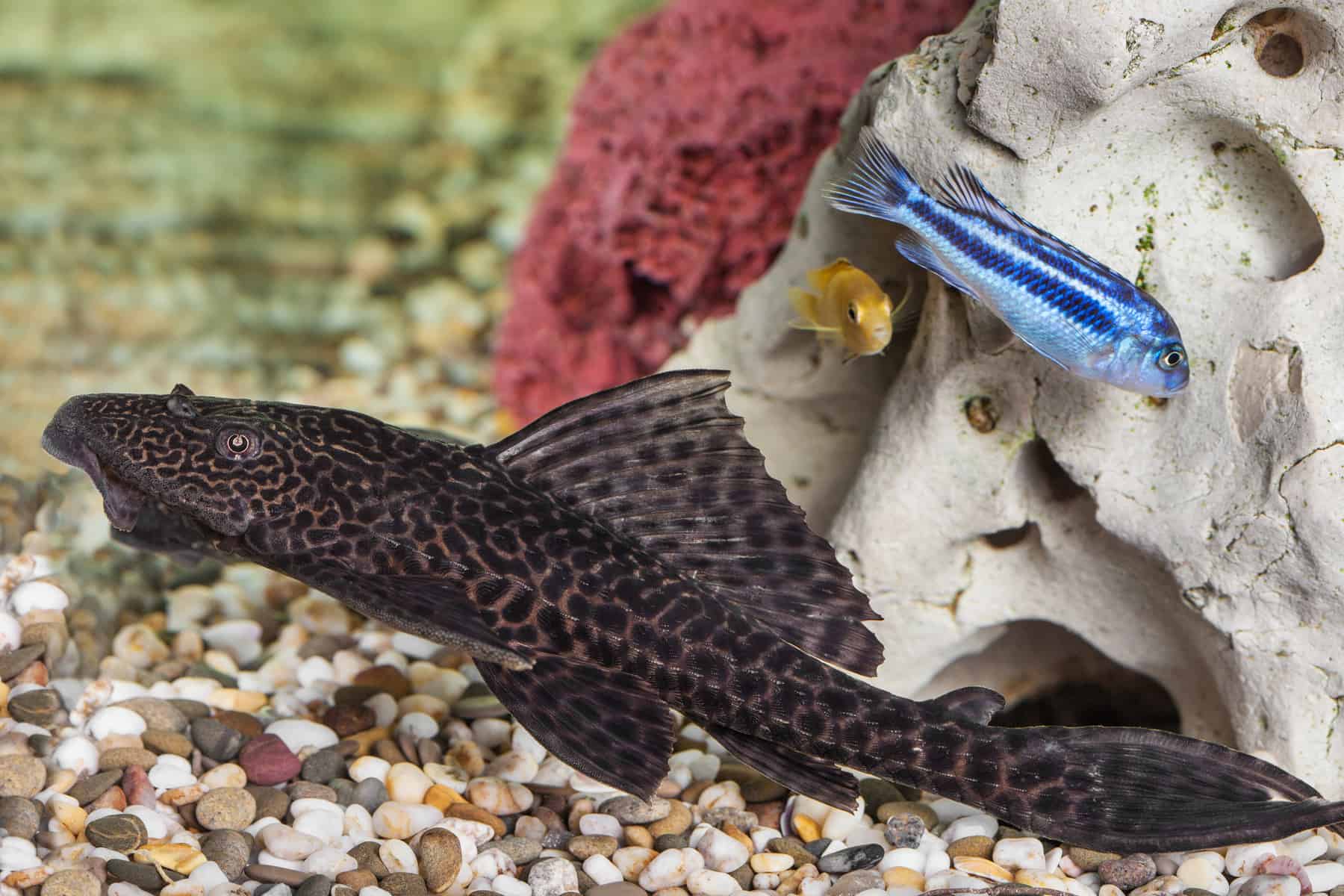
The Rubber Lipped pleco is often confused with the Rubber pleco, Parancistrus aurantiacus, and it’s not uncommon for the two species to be advertized incorrectly by fish stores.
The most obvious differences between the two species are their coloration and maximum growth size.
The Rubber Lipped pleco has spots on its head and nose and reaches no more than 5 inches in length, whereas the Rubber pleco has a crisscrossed pattern of stripes, growing to a length of up to 7 or even 8 inches. Also, the Rubber pleco changes from gray to a goldish color as it matures.
It’s worth noting that most of the plecos that you see for sale in fish and pet stores are juveniles. So, remember that your fish will grow slowly until it eventually makes its full size of around five inches.
Habitat and origins
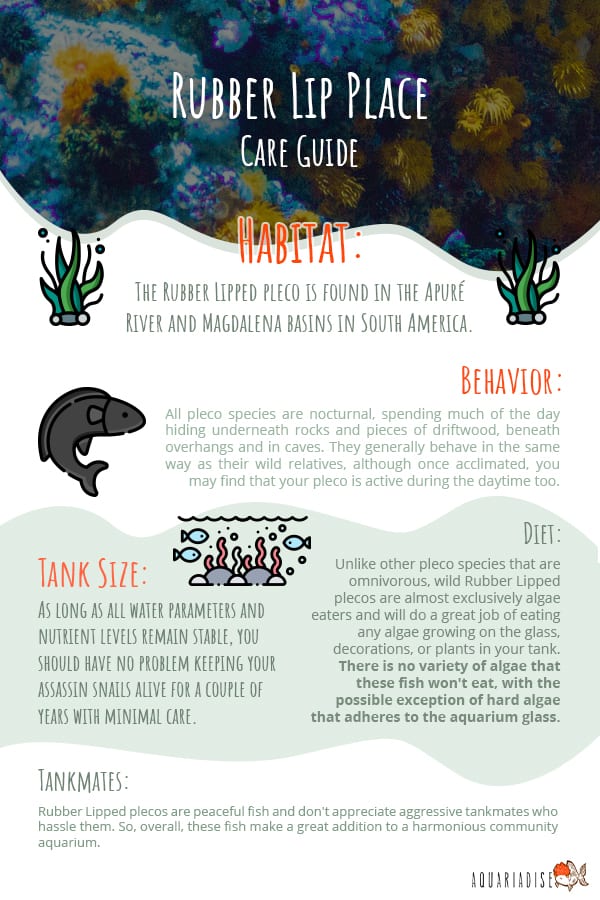
The Rubber Lipped pleco is found in the Apuré River and Magdalena basins in South America.
The Rio Magdalena flows through western Colombia with its source in the Huila Department of the south of the country. The Magdalena is bordered by two Andean Mountain subranges, eventually flowing to the coastal plains where it empties into the Caribean. The Rio Apuré is a confluence of the Rio Uribante and the Rio Sarare in western Venezuela. To the West of Cabruta, the river flows into the Orinoco.
In some parts of the river network, the water temperature drops, so the Rubber Lipped pleco may be regarded as a cold water pleco.
The Common pleco has been found in several of the southern United States, where the species is regarded as invasive.
Behavior
All pleco species are nocturnal, spending much of the day hiding underneath rocks and pieces of driftwood, beneath overhangs and in caves.
Rubber Lipped plecos in the aquarium generally behave in the same way as their wild relatives, although once acclimated, you may find that your pleco is active during the daytime too.
Care of the Rubber Lipped pleco
Plecos can live for up to 12 years and are relatively robust and healthy fish, and they are relatively easy to care for, provided that you provide the right tank conditions and diet.
Tank size
Plecos are slow growers, growing perhaps an inch or so each year, and not reaching their maximum size for a few years. However, you should still use a large aquarium that’s long rather than tall so that these bottom-dwellers have plenty of scavenging space.
It’s recommended that you should not keep any species of pleco in a tank with a capacity of fewer than 25 gallons. Also, the pleco is a territorial fish when kept with others of the same species, other plecos, and catfish. So, if you want to keep more than one pleco, you will need to provide an aquarium of at least 55 gallons.
Diet and feeding
Unlike other pleco species that are omnivorous, wild Rubber Lipped plecos are almost exclusively algae eaters and will do a great job of eating any algae growing on the glass, decorations, or plants in your tank. There is no variety of algae that these fish won’t eat, with the possible exception of hard algae that adheres to the aquarium glass. So, if you have a problem with overgrowth of algae in your tank, a pleco or two could be the answer to your prayers!
However, sometimes, the pleco will lose interest in the natural algal growth in the aquarium, preferring to eat other foods, such as wafers or herbivore flakes. That tends to happen when the fish were offered an alternative diet from an early age.
That said, if the supply of algae becomes scarce in your tank, you must offer your pleco a selection of alternative foods to provide a varied and nutritious diet, including:
- fresh zucchini
- spinach
- algae wafers
- high-quality fish flakes
- peas
- Romaine lettuce
- spirulina
- cucumber
- seaweed algae sheets
Plecos won’t eat or damage your plants. If you see your Rubber Lipped pleco sucking on plant leaves, he will be busy feeding on the algae that are growing there. Plecos will also search for tidbits among the substrate.
It’s worth noting here that plecos are mainly nocturnal. So, if you feed your fish before lights-out, they will keep busy eating once the “sun” has set.
Tankmates
Rubber Lipped plecos are peaceful fish and don’t appreciate aggressive tankmates who hassle them. So, overall, these fish make a great addition to a harmonious community aquarium.
That said, despite their laid-back image, Rubber Lipped plecos can be quite territorial among their own species and with other plecos. However, provided that the aquarium is large enough and there’s plenty of space, you should not really have a problem.
Rubber Lipped plecos do not generally breed well in home aquariums, largely because there is insufficient space. For that reason, you need not concern yourself with trying to find a male and female pleco to create a mated pair.
Tank decoration
Like the Common pleco and most other species of plecos, the Rubber Lip likes a riverbed environment that has plenty of smooth-surfaced rocks and driftwood that it can rest on, as well as lots of plants.
Plecos are quite shy and need plenty of hiding places and caves to which they can retreat if feeling threatened or stressed. Somewhere to hide is very important for this species, as stress may predispose them to disease and prevents the fish from thriving and growing as it should.
The Rubber Lipped pleco lives in a wild environment that contains plenty of plants and vegetation. So, you’ll need to replicate that in your home tank. Aquariums that are heavily planted off the pleco plenty of sheltered spots where it can chill-out during the daylight hours.
Water conditions
It’s essential that you provide your Rubber Lip pleco with its preferred water conditions to prevent stress and keep your fish healthy.
Plecos prefer a water pH of 6.5 to 7.5 and KH levels in the range of 8 to 12. The water temperature should be between 700 and 780 Fahrenheit. The filter system in the tank should be efficient, providing a medium to high water flow and a well-aerated environment.

Breeding
At the time of writing, there are no reports of Rubber Lipped plecos being successfully bred by hobbyists in home aquariums. That’s thought to be because it has not been possible to recreate the pleco’s natural environment and provide sufficient space for spawning behavior to take place.
Availability
Most fish shops sell a few varieties of plecos. However, the Rubber Lipped pleco is not as readily available as the Common pleco, so an online search of .com stores may be necessary to find these unusual, attractive plecos. Specialist dealers usually offer a postal service, or a pet store may be able to get you one of these plecos.
FAQ
In this section of our guide, we answer a few of the questions that are most often asked by people who are considering keeping one of these fish to their community aquarium.
Q: Do Rubber Lip plecos need driftwood?
A: Rubber Lipped plecos really enjoy resting on driftwood and attaching themselves to it to suck any algae off the surface. Also, driftwood is found in the pleco’s natural riverbed environment, so, including some pieces of driftwood may help to make your pleco feel more at home in the aquarium.
Q: Are Rubber Lip plecos good algae eaters?
A: Yes, all species of pleco eat algae. However, you should also provide your fish with other plant-based foods, including algae wafers, fresh peas, zucchini, spinach, Romain lettuce, and seaweed sheets. That mix gives your fish a nice variety of nutritious food that he will like and which will keep him healthy.
Q: Can Rubber Lip plecos live with goldfish?
A: This type of pleco can live with goldfish. Most goldfish aquariums maintain a room temperature of between 700 and 780 Fahrenheit, which is fine for plecos. The goldfish live in all areas of the tank, while the pleco spends its time on the bottom, so the two will not come into conflict.
Q: How can you tell the sex of a Rubber Lipped pleco?
A: The Rubber Lipped pleco is notoriously difficult to sex. However, when viewed from above, the female has a more rounded body, and males are typically more slender. From a side view, the female’s abdomen appears rounder and longer in relation to the rest of her body.
Q: Does a Rubber Lipped pleco have teeth?
A: Although plecos are known as algae suckers, they do have teeth. In fact, a pleco’s teeth are so strong that some species cannot be kept in acrylic tanks, as their teeth will scratch the tank surface!
Final thoughts
If you want a peaceful algae-eater to add to your tropical aquarium, a Rubber Lipped pleco could be what you’re looking for.
The Rubber lip doesn’t grow as large as other pleco species, making it a good choice for the home aquarium. That said, you should not keep one of these creatures in an aquarium that has a capacity of under 25 gallons, as they do grow up to 5 inches in length.


