You’ve run out of substrate space but you’re not done adding plants. Maybe you want greenery at eye level, or your bottom-dwelling fish keep uprooting everything. Whatever the reason, you’re looking for a way to grow aquarium plants off the bottom of your tank — and glass plant cups might be exactly what you need.
Quick Answer
Glass aquarium plant cups are small suction-cup planters that attach to your tank walls, letting you grow rooted plants at any height. They’re inexpensive ($2-5), easy to set up, and work with most substrates — though coarser materials like aquasoil or gravel hold better than fine sand.
What Is an Aquarium Plant Cup?
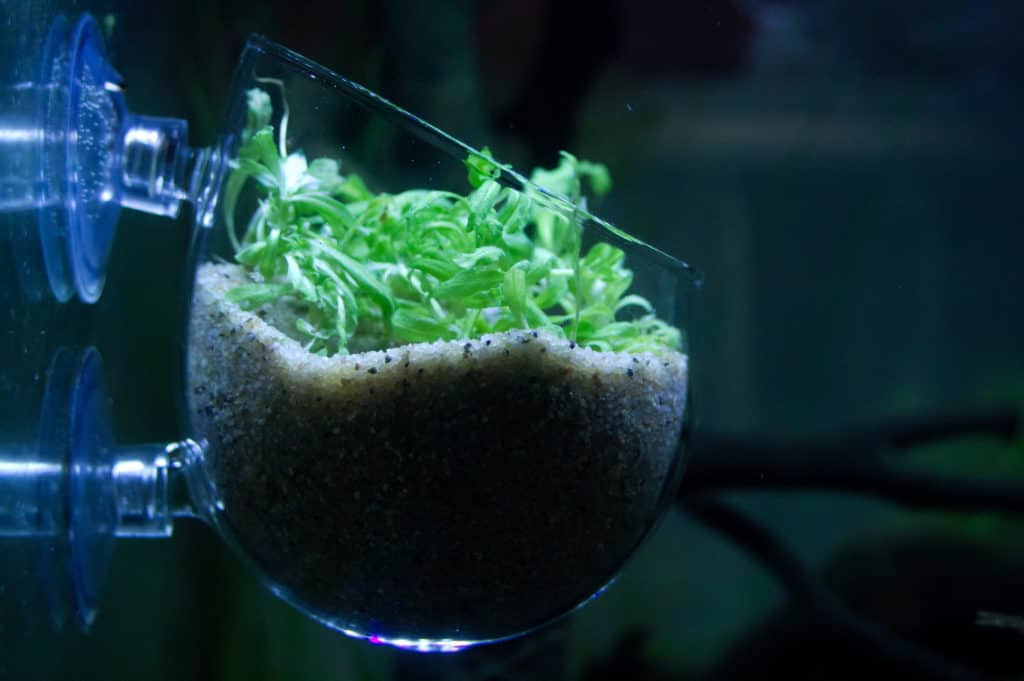
An aquarium plant cup is a small glass container — usually 2-3 inches in diameter — with suction cups attached to the back. You fill it with substrate, plant your chosen species, and stick it anywhere on your aquarium glass. It’s a beautifully simple concept that opens up vertical planting possibilities most hobbyists never consider.
Before these became widely available, your options for mid-tank or upper-tank greenery were limited. You could use mesh ledges or driftwood to attach epiphytes like Anubias and Java fern, but rooted plants that need substrate were stuck on the bottom. Plant cups change that entirely — now you can grow stem plants, carpeting species, or pretty much anything at whatever height you want.
? Beyond plants: Some aquarists repurpose these cups as feeding stations. Drop food into the cup instead of scattering it across the tank, and your fish learn exactly where to find their meals. This keeps substrate cleaner and makes it easier to remove uneaten food.
How to Set Up Your Plant Cup
Setting up a glass plant cup takes just a few minutes, but doing it right the first time saves you from chasing floating plants around your tank.
My Honest Review: What Worked and What Didn’t
I ordered one of these plant cups for my 8-gallon cube tank, and honestly? I’m a little annoyed I didn’t try this years ago. It’s such a simple, inexpensive way to add more greenery without overcrowding the substrate or constantly fighting with floating plants.
For my test, I filled the cup with filter sand and planted several Pogostemon helferi cuttings (a beautiful foreground plant sometimes called “downoi”). The plants rooted well over the following weeks, and the cup stayed firmly attached to the glass through water changes and general tank maintenance.
?? Important: Avoid Fine Sand
Most glass plant cups have a small drainage hole at the bottom for water circulation. This is great for plant health — but fine sand will slowly leak out every time you move the cup. I learned this the hard way. Stick with aquasoil, small gravel, or coarser planted tank substrates for best results.
The suction cups have remained secure for months now, even on the side of the tank that gets direct afternoon light (which I initially worried might affect adhesion). The glass construction looks elegant and nearly disappears against the tank wall — much cleaner than plastic alternatives.
? Pro Tip
For an even cleaner look, position the cup where tank equipment or hardscape partially hides the suction cups from your main viewing angle. The plants become the focal point while the hardware disappears.
Best Plants for Aquarium Plant Cups
While you can technically grow almost any rooted plant in these cups, some species work better than others. Compact plants with smaller root systems are ideal — you’re working with limited substrate volume.
| Plant | Why It Works | Light Needs |
|---|---|---|
| Pogostemon helferi | Compact rosette, stays small | Medium-High |
| Cryptocoryne parva | Tiny, slow-growing, hardy | Low-Medium |
| Monte Carlo | Cascades over cup edges beautifully | Medium-High |
| Staurogyne repens | Bushy but controllable | Medium |
| Dwarf Hairgrass | Creates a “floating meadow” effect | Medium-High |
Avoid large stem plants that will quickly outgrow the cup or species with aggressive root systems. The cup’s substrate volume can only support so much growth before nutrients become limiting. [INTERNAL LINK: “low-light aquarium plants” -> beginner aquarium plants]
Where to Buy Glass Plant Cups
Here’s the good news: these cups are remarkably affordable, and there’s very little quality difference between budget and premium options. As long as the cup is actual glass (not acrylic) and the suction cups are decent quality, you’re good to go.
? Price Comparison
- Amazon: $4-8 with Prime shipping (search “glass aquarium plant cup”)
- AliExpress: $2-3 if you don’t mind 2-4 week shipping
- Local fish stores: $8-12 typically, but supports local businesses
- Aquascaping specialty shops: $10-15 for “premium” versions that work identically
I purchased mine from AliExpress for under $2.50 since I wasn’t in a hurry. It arrived in about three weeks and has performed flawlessly. If you want it faster, Amazon carries essentially identical cups for a few dollars more with quick shipping.
Some sellers offer plant cups in different sizes (typically 3cm, 4cm, and 5cm diameter) and shapes (round, oval, square). The round design is most common and works well for most applications. Larger cups hold more substrate and suit bigger plants but are also more visible.
Frequently Asked Questions
Will the suction cups fall off over time?
Quality suction cups can hold for months or even years if applied to clean glass. Algae buildup on the glass where the suction cup attaches is the main cause of failure. If your cup starts slipping, remove it, clean both the suction cups and the glass surface, and reattach.
Can I use these cups in a saltwater aquarium?
Yes, glass is completely reef-safe. However, macroalgae typically grown in saltwater tanks (like chaetomorpha) often don’t need substrate and are better suited to refugiums. These cups are most useful for freshwater planted tanks.
Do I need to fertilize plants in the cup differently?
The limited substrate means root feeders may benefit from root tabs placed in the cup, especially in nutrient-poor substrates. Water column fertilizers will reach the plants normally. Using nutrient-rich aquasoil from the start reduces the need for supplemental fertilization.
Will shrimp or snails knock the cup off the glass?
Shrimp and most snails are far too light to dislodge a properly attached cup. Larger snails like mystery snails might bump into it, but a secure suction cup seal will hold. The bigger concern is fish — avoid placing cups where large, boisterous fish might collide with them.
Can I attach plant cups to acrylic tanks?
Suction cups generally work on acrylic, but the seal may not be as strong as on glass. Test with the cup empty first to make sure it holds before adding substrate and plants. Some aquarists report needing to reattach more frequently on acrylic surfaces.
If you have questions about glass plant cups or want to share your own vertical planting experiments, leave a comment below! And if you’re looking for more ways to add greenery to your tank, check out our guide to [INTERNAL LINK: “floating aquarium plants” -> floating plants] — another great option for tanks where substrate space is limited.