
Keeping a Red Terror cichlid isn’t for the faint of heart. These 18-inch predators earned their name honestly — they’re territorial, aggressive, and will absolutely dominate a tank that’s too small or stocked with the wrong tankmates. But for experienced keepers who can provide the right environment, few freshwater fish match their combination of size, color, and personality.
Quick Care Overview
Scientific Name: Amphilophus festae
Adult Size: 13″ (female) / 18″ (male)
Minimum Tank: 180 gallons
Temperature: 77-84°F
pH Range: 6.0-8.0
Lifespan: 12-15 years
Diet: Carnivore (pellets, live/frozen foods)
Difficulty: Advanced
Natural Habitat and Origin
Red Terror cichlids (also called Harlequin cichlids or True Red Terrors) are native to the rivers and tributaries of western South America, ranging from Ecuador’s Río Esmeraldas down to Peru’s Río Tumbes basin. They’ve also established invasive populations in Singapore.
In the wild, these fish inhabit areas with strong water flow, typically staying in the middle to lower water column. They shelter in undercut banks and beneath overhanging branches, hunting small fish, crustaceans, and insects along vegetated shorelines.
Coloration and Sexual Dimorphism
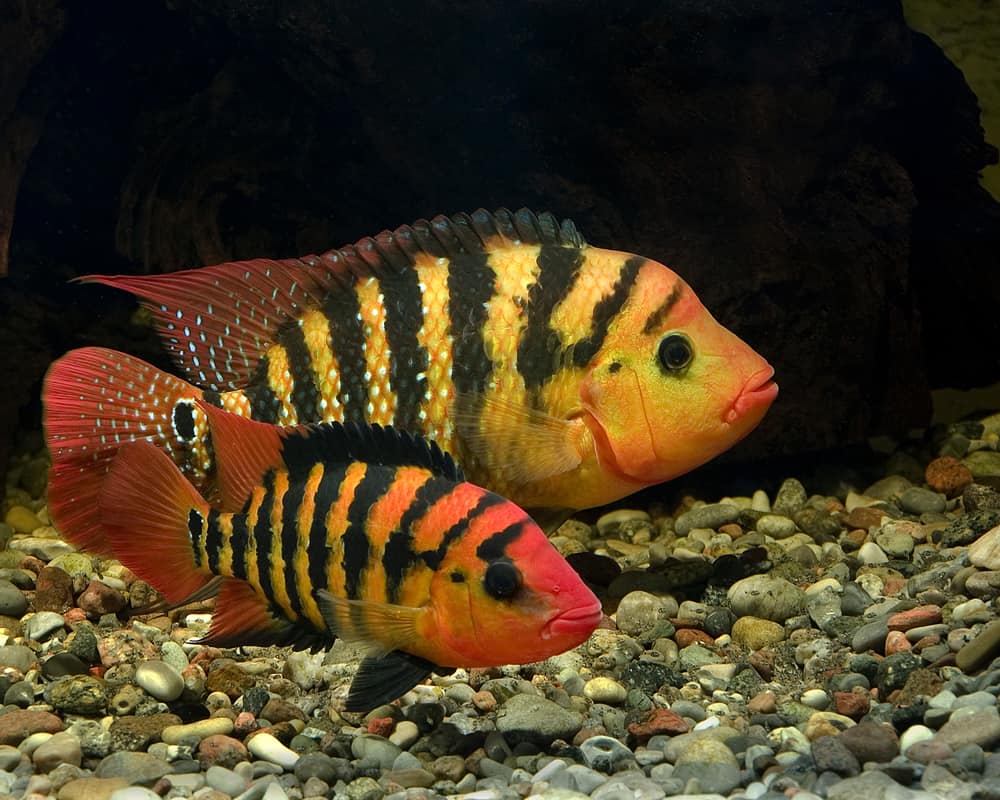
Female Red Terrors are the showstoppers — bright red bodies marked with vertical black bars and iridescent blue spots. Their snouts flush reddish-orange, and breeding females intensify to truly spectacular coloration.
Males look quite different: turquoise-green bodies with orange fins and blue-spotted tails. As males age, their colors actually fade, and by around three years old, they develop a prominent nuchal hump (forehead bump) characteristic of many large cichlid species.
Juveniles of both sexes start gray with dark lateral stripes, gradually developing their adult coloration as they grow.
Tank Requirements
Tank Size
A single Red Terror needs at least 180 gallons — and that’s the minimum. Choose a long, wide tank over a tall one; these fish need horizontal swimming space. If you’re keeping tankmates, plan for significantly more volume.
[WARNING] Don’t Undersize the Tank
Keeping a Red Terror in a tank under 180 gallons virtually guarantees aggression problems, stress, and a shortened lifespan. These fish grow fast and need room to establish territory.
Substrate and Decoration
Use sand, fine gravel, or a mix for the substrate — but keep it shallow (quarter-inch or less). Red Terrors are prolific diggers and messy eaters, and deep substrate traps waste that degrades water quality quickly.
Include driftwood, rocky caves, and sturdy decorations that create distinct territories. If you want live plants, anchor them extremely well or use potted plants — these fish will uproot anything that isn’t secured.
Water Parameters
Large cichlids produce substantial waste, so robust filtration is non-negotiable. You’ll need strong mechanical and biological filtration rated well above your tank’s volume.
| Parameter | Ideal Range |
|---|---|
| Temperature | 77-84°F (25-29°C) |
| pH | 6.0-8.0 |
| KH (Hardness) | 2-10 dKH |
| Ammonia/Nitrite | 0 ppm |
| Nitrate | Below 20 ppm |
Red Terrors are sensitive to parameter swings. Test water weekly and perform regular water changes — monthly at minimum, weekly if your bioload is high.
Diet and Feeding
Red Terrors are carnivores with strong predatory instincts. Base their diet on high-quality cichlid pellets formulated for large species, then supplement with variety:
- Earthworms, mealworms, and crickets
- Frozen foods (krill, silversides, prawns)
- Occasional feeder fish or ghost shrimp to stimulate hunting behavior
- Protein-rich treats like beef heart or chicken liver (sparingly)
Feed once or twice daily, offering only what they can consume in about five minutes. Overfeeding contributes to the water quality issues these messy fish already create.
Tankmates
The Red Terror’s reputation is well-earned — these fish are aggressive, territorial, and will attack or kill unsuitable tankmates. Successful community setups require other large, assertive species that can hold their own:
- Large cichlids: Oscars, Green Terrors, Managuense cichlids
- Flowerhorn cichlids
- Large plecos: Sailfin pleco, common pleco
- Arowana (in appropriately massive tanks)
[FACT] Choose tankmates that differ in body shape and feeding behavior from your Red Terror. Fish that don’t compete directly for the same resources are less likely to trigger territorial aggression.
Managing Aggression
Some level of aggression is unavoidable with this species, but you can minimize problems:
Provide defined territories. Use rocks, driftwood, and decorations to create distinct zones. Each fish needs a defensible space they can claim as their own.
Choose tankmates strategically. Large, differently-shaped fish that occupy different parts of the water column are less likely to be viewed as competitors.
Consider slight overstocking. Counterintuitively, a moderately overstocked tank can diffuse aggression by preventing any single fish from being singled out. This requires excellent filtration and diligent maintenance.
Never house a breeding pair with other fish. Breeding Red Terrors become hyper-aggressive and will either kill tankmates or terrorize them into a corner. Move breeding pairs to a dedicated tank.
Breeding Red Terror Cichlids
Red Terrors reach sexual maturity at 3-4 inches, when they begin showing adult coloration. These fish prefer to choose their own mates — forcing a pairing often results in fighting, and females have been known to kill males they consider unsuitable.
Did You Know?
Female Red Terrors “test” potential mates by locking jaws with them. This lets her gauge the male’s strength — if she decides he’s too weak to father strong offspring, she may reject or even attack him.
Once paired, Red Terrors often bond for life. To encourage spawning:
- Raise temperature to 79-82°F
- Reduce pH toward 7.0
- Provide a spawning site — a large terracotta pot on its side or a rocky cave works well
Females lay 10-100 eggs, which hatch in approximately four days. Both parents guard the eggs and fry aggressively. They’ll excavate small pits in the substrate where the fry shelter as they develop.
Remove fry to a separate rearing tank to prevent predation by other tank residents. Start them on baby brine shrimp (nauplii), gradually introducing larger foods as they grow.
Where to Buy and Pricing
Red Terrors aren’t commonly stocked at general pet stores. Check specialty aquarium shops, or expect to order online from cichlid breeders. Prices typically range from $30-100 depending on size and coloration, plus shipping costs for online orders.
Frequently Asked Questions
How big do Red Terror cichlids get?
Females reach about 13 inches, while males grow larger at up to 18 inches in captivity. Males also develop a distinctive forehead hump (nuchal hump) around age three.
How fast do Red Terror cichlids grow?
They grow rapidly in their first year — females to around 7 inches, males to 9 inches. Growth slows to roughly one inch per year after that. In a large tank with good nutrition, males can reach 12 inches by year three.
Can Red Terror cichlids live with other fish?
Yes, but only with other large, aggressive species like Oscars, Flowerhorns, or Managuense cichlids. Never house them with peaceful or small fish. Breeding pairs should always be kept alone.
What is the most aggressive cichlid species?
The Wolf cichlid (Parachromis dovii) is generally considered the most aggressive cichlid. Red Terrors rank among the more aggressive commonly kept species.
Are Red Texas cichlids the same as Red Terror cichlids?
No. Red Texas cichlids are man-made hybrids (likely derived from Flowerhorn crosses) that don’t exist in the wild. Red Terrors (Amphilophus festae) are a distinct natural species from South America.
Final Thoughts
Red Terror cichlids reward experienced keepers with stunning coloration, engaging behavior, and genuine personality. They’re not community-friendly and they demand substantial space and filtration — but if you can meet their needs, they’re among the most impressive cichlids you can keep.
Make sure you have the tank size, filtration capacity, and compatible tankmates sorted before bringing one home. Get it right, and you’ll have a centerpiece fish that can live 15 years or more.
[INTERNAL LINK: “large cichlid species” -> Texas Cichlid care guide]
[INTERNAL LINK: “aggressive cichlid tankmates” -> Oscar care guide]


