
Quick Answer
Hygrophila species are among the hardiest aquarium plants available. They tolerate pH 5.0-8.0, temperatures 64-86F, and grow in low light without CO2. The main challenge is keeping them from taking over your tank.
Your new planted tank looks sparse. The expensive stem plants you bought are melting. Meanwhile, that scruffy Hygrophila cutting your friend threw in as an afterthought is already reaching the waterline. That’s Hygrophila in a nutshell — the plant that thrives on neglect while fussier species die around it.
There are roughly 80-100 species in the Hygrophila genus (family Acanthaceae), with three dominating the aquarium trade: H. polysperma, H. corymbosa, and H. costata. Each has slightly different aesthetics, but they share the same bulletproof constitution that makes them ideal for beginners and low-tech setups.
Why Hygrophila Actually Survives When Other Plants Don’t
Most aquarium plant care guides focus on what plants need. With Hygrophila, the better question is what it tolerates — which is almost everything.
The secret is that Hygrophila species are water column feeders. Their roots anchor them, but they pull most nutrients directly from the water. This means they don’t care whether your substrate is aquarium soil, sand, gravel, or bare-bottom. They’ll adapt.
[FACT] Hygrophila polysperma is classified as a Federal Noxious Weed in the United States. It’s illegal to import or sell across state lines — a testament to how aggressively it grows when conditions allow.
This same aggressive growth is why Hygrophila works so well in new tanks. It outcompetes algae for nutrients, helps establish biological stability, and provides immediate cover for shy fish. Once your tank matures and you want to add more demanding plants, Hygrophila has already done the hard work of balancing your water column.
Hygrophila polysperma (Dwarf Hygro)
The most common and arguably hardiest of the aquarium Hygrophilas. Also sold as Indian Waterweed or Dwarf Hygrophila. Native to Southeast Asia, now naturalized across warmer regions worldwide — including parts of Florida, Texas, and Virginia where it’s considered invasive.
H. polysperma Quick Care
The Catch With Polysperma
Before you order this plant online, check your state’s regulations. Because H. polysperma is federally listed as a noxious weed, interstate sale and transport is prohibited. Some states have additional restrictions. This isn’t bureaucratic overreach — released into warm waterways, polysperma chokes out native vegetation.
If you’re in a restricted state, H. corymbosa is your best legal alternative with similar hardiness.
Growing and Maintaining Polysperma
Plant stems directly into your substrate. For the first week or so, they’ll float free if disturbed — use plant weights or bury an extra inch of stem until roots establish. After that, you won’t be able to stop it.
Polysperma grows in low light. It grows faster in high light. Under strong lighting with CO2, it becomes almost comically vigorous — expect weekly pruning to keep it contained.
[TIP] Pro Tip
When you prune polysperma, don’t throw away the cuttings. Plant them. A single healthy stem can become a dozen plants within a month. This is how experienced hobbyists fill new tanks for free.
Trace mineral supplements after water changes help maintain color, but aren’t strictly necessary. In hard water, polysperma often shows attractive pink or reddish tones on new growth.
Tank Mates
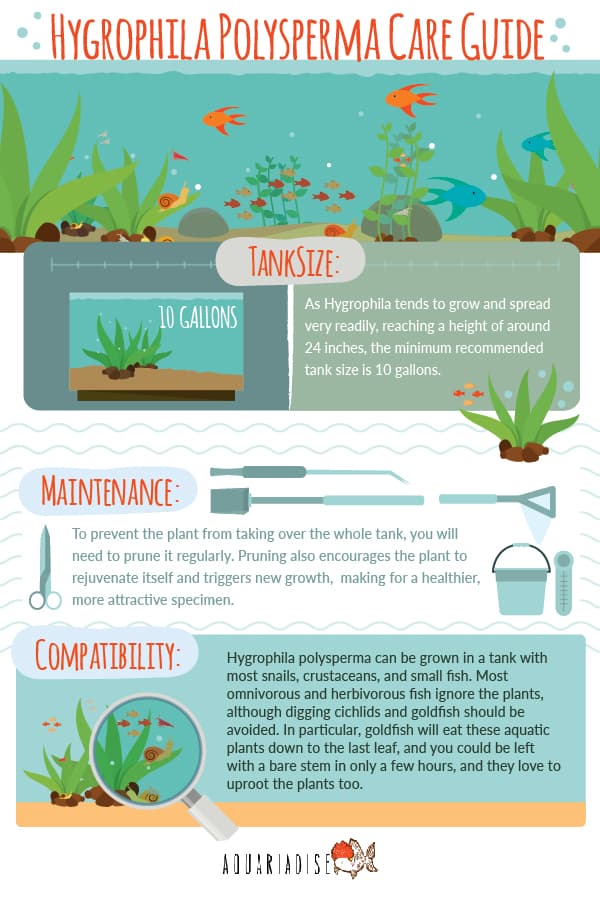
Compatible with most community fish, shrimp, and snails. The one exception: goldfish. A hungry goldfish will strip polysperma to bare stems overnight, then uproot what’s left for good measure. Digging cichlids cause similar problems. If you keep either, skip Hygrophila entirely.
Hygrophila corymbosa (Temple Plant)
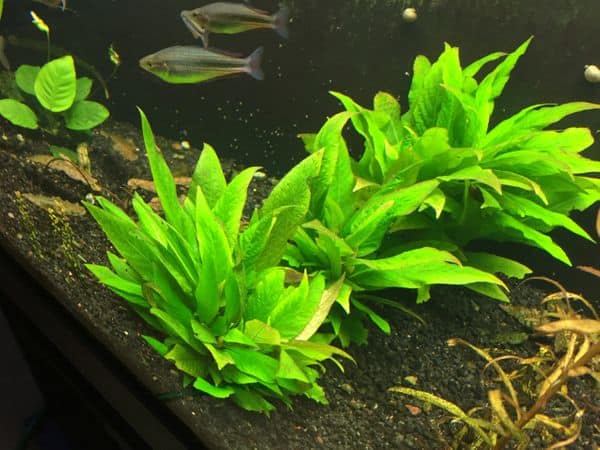
The larger, showier cousin of polysperma. Temple plant produces wide, bright green leaves that can develop pink or magenta shading under high light. It’s often the better choice for aquascaping because it grows more compactly and has more visual impact.
H. corymbosa Quick Care
Where Corymbosa Differs
Unlike polysperma, corymbosa genuinely benefits from CO2 supplementation and nutrient-rich substrate. It’ll survive without them, but growth slows and leaves stay smaller. If you’re running a [INTERNAL LINK: “CO2 system” -> DIY CO2], corymbosa responds beautifully.
Corymbosa also prefers brighter light than polysperma. Under low light, it becomes leggy and loses its compact, bushy form. Aim for medium-high intensity for best results.
[WARNING] Iron Deficiency
Yellowing leaves on corymbosa usually indicate iron deficiency, not lighting problems. Add a comprehensive liquid fertilizer with iron, or use root tabs near the base of established plants.
Maintenance is straightforward: prune tops when they reach the surface, remove dead lower leaves, and replant cuttings as desired. New growth emerges from the stems, so regular trimming actually creates a denser, more attractive plant.
Hygrophila costata (Gulf Swampweed)
The South American species, also found throughout Central America, the Caribbean, and Florida. Costata was long mislabeled as “Hygrophila corymbosa angustifolia” in the trade — if you see that name, you’re actually looking at costata.
Costata has narrower, more closely-spaced leaves than corymbosa, giving it a distinctly different texture in the aquascape. Commercially grown specimens often have rounder, wider-spaced leaves than wild-collected plants.
H. costata Quick Care
Care mirrors corymbosa: bright light, optional CO2, regular pruning. Costata’s growth rate is aggressive even by Hygrophila standards — in a small tank, one plant can dominate the entire background within weeks.
Comparing the Three Species
| Species | Best For | Light Needs | Legal Status (US) |
|---|---|---|---|
| H. polysperma | Low-tech tanks, absolute beginners | Any | Federal noxious weed — restricted |
| H. corymbosa | Aquascaping, visual impact | Medium-high | Legal in most states |
| H. costata | Dense background, fast fill | Medium-high | Legal in most states |
Propagation: Easier Than You’d Expect
All Hygrophila species propagate the same way: cut a stem, plant it, wait. That’s genuinely all there is to it.
For polysperma specifically, you can propagate from a single leaf — just press it gently into the substrate. This won’t work reliably with corymbosa or costata, which need at least a stem node to generate new growth.
When propagating, leave space between plantings. These aren’t slow-growing crypts that stay where you put them. A group of Hygrophila cuttings planted two inches apart will be a solid wall of green within a month.
Did You Know?
All Hygrophila species are emergent plants — they can grow partially above water. In paludariums or open-top tanks, Hygrophila will grow out of the water and may even flower. Keep tops trimmed if you don’t want this, or the emersed growth can shade out submerged leaves.
The Real Maintenance Challenge
Here’s what most Hygrophila guides won’t tell you directly: the hard part isn’t keeping these plants alive. It’s keeping them from overwhelming everything else in your tank.
In a low-tech setup, expect to prune every two weeks. In a high-tech tank with CO2 and strong light, weekly pruning is more realistic. Miss a few sessions and you’ll find your carefully planned aquascape has become a Hygrophila monoculture.
The solution is aggressive, guilt-free pruning. Cut stems back to a few inches above the substrate. Remove entire plants if they’re crowding neighbors. Throw away cuttings you don’t need — or trade them to other hobbyists. The plant doesn’t mind. It’ll grow back regardless.
Frequently Asked Questions
Can Hygrophila grow in low light without CO2?
Yes — H. polysperma specifically will grow in almost any light without supplemental CO2. Corymbosa and costata prefer moderate light and grow better with CO2, but will survive without it. Growth rate and coloration suffer in low-light, low-tech conditions, but the plants persist.
Why is my Hygrophila losing lower leaves?
Lower leaf loss usually means insufficient light reaching the bottom of the plant, especially if top growth is dense. Prune the canopy to allow light penetration, or remove affected stems and replant the healthy tops. This is normal plant behavior, not a crisis.
Is Hygrophila polysperma illegal to buy?
In the US, H. polysperma is a Federal Noxious Weed. Interstate sale and transport is prohibited. Some states have additional restrictions. Check local regulations before purchasing. H. corymbosa and H. costata are legal alternatives with similar care requirements.
Can Hygrophila grow out of water?
Yes. Hygrophila species are emergent plants that naturally grow partially above water. In open-top tanks or paludariums, stems will grow emersed and may produce purple flowers (corymbosa especially). Keep stems trimmed below the waterline if you prefer fully submerged growth.
What’s the difference between Hygrophila siamensis and corymbosa?
They’re the same plant. “Hygrophila siamensis” is an older trade name for Hygrophila corymbosa. You may also see it sold as “Temple Plant” or “Giant Hygro.” Care requirements are identical regardless of label.
Hygrophila won’t win awards for rarity or difficulty. What it offers instead is reliability — a plant that fills space, outcompetes algae, and keeps growing through beginner mistakes that would kill more demanding species. For new planted tanks or low-maintenance setups, that’s exactly what you need.


