

Quick Answer
Denison barbs (Sahyadria denisonii) need a minimum 55-gallon long tank with strong current, cooler temperatures (59-77F), and a school of at least six. They’re active, semi-aggressive when understocked, and not beginner-friendly due to their sensitivity to water quality.
You’ve seen them at the fish store — those stunning torpedo-shaped fish with the bright red stripe running through the eye. Then you checked the price tag. Denison barbs aren’t cheap, and there’s a reason for that beyond their looks: they’re endangered in the wild, and keeping them well requires more than most barb species demand.
Here’s what most care guides won’t tell you upfront: Denison barbs are one of the most commonly returned fish at quality fish stores. People buy two or three, put them in a 30-gallon, and wonder why they’re aggressive, stressed, and fading. This guide covers what actually works.
Species Overview
The Denison barb goes by a confusing number of common names: Roseline shark, red-lined torpedo barb, Miss Kerala, Denison’s flying fox, and bleeding eye barb among them. The scientific name has also shifted — you’ll see both Puntius denisonii and the current Sahyadria denisonii.
Whatever you call them, these fish reach 4-6 inches in captivity and can live around five years with proper care. They originate from fast-flowing, well-oxygenated rivers in the Western Ghats mountain range of Kerala, India — which tells you almost everything you need to know about their care requirements.
Quick Care Overview
Colors and Markings
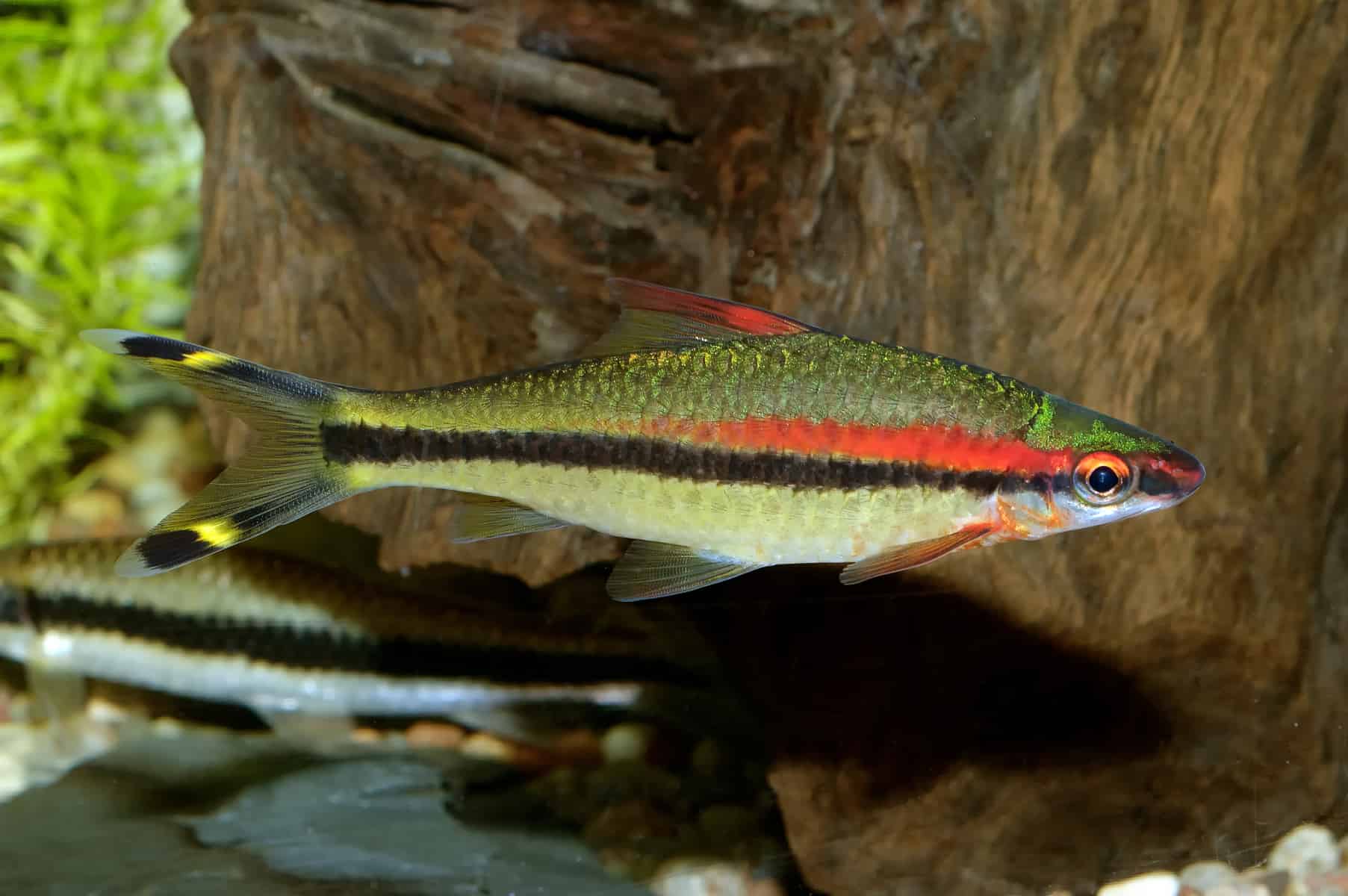
The torpedo body shape is immediately distinctive. A black lateral line runs from snout to tail, with a brilliant scarlet stripe running parallel from the nose through the eye to mid-body. The dorsal fin develops a red edge in mature specimens, and the caudal fin shows yellow and black striping. Some adults develop a greenish hue on the head — this is normal and often a sign of good health and maturity.
A gold variant has appeared in recent years that lacks the black stripe entirely. These are sometimes sold as “Golden Roseline Sharks” at a premium.
Like other barbs, they have barbels near the mouth that help them locate food in the substrate.
[FACT] Sexing Denison barbs is notoriously difficult. Females tend to be slightly larger and heavier-bodied with less intense coloration, but these differences are subtle enough that even experienced keepers can’t reliably sex them outside of spawning condition.
Conservation Status
This is one of those uncomfortable truths the hobby needs to acknowledge: Denison barbs are IUCN endangered, primarily because of overharvesting for the aquarium trade combined with habitat destruction and pollution in their native Kerala rivers.
The good news is that commercial breeding programs in Eastern Europe and Southeast Asia now supply most of the fish you’ll find for sale. Wild collection is seasonally restricted in India. If you’re buying Denison barbs, ask your source whether they’re captive-bred — reputable sellers will know.
Tank Requirements
Size Matters More Than Usual
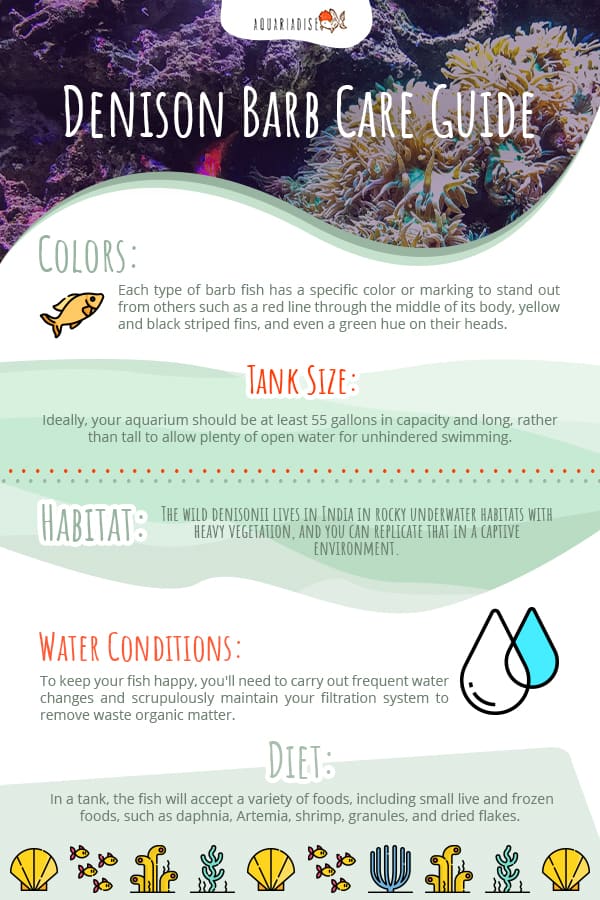
The 55-gallon minimum you’ll see everywhere isn’t arbitrary — it’s the bare minimum, and a 75-gallon or larger is genuinely better. More importantly, tank shape matters. A long, shallow tank is far superior to a tall one. These fish are horizontal swimmers that cover ground constantly. A 55-gallon long gives them the runway they need; a 55-gallon tall does not.
I’ve seen Denison barbs in 40-gallon breeders that seemed happy enough, but the school was small and the tank was otherwise understocked. If you’re planning a proper community, don’t cut corners on tank size.
[WARNING] The Jumping Problem
Denison barbs are notorious jumpers, especially when startled or during feeding. A tight-fitting lid is non-negotiable. I’ve heard too many stories of someone finding their $30 fish dried out on the floor because they left a 2-inch gap for airline tubing.
Habitat Setup
Think river, not pond. Rocky substrate with rounded pebbles of varying sizes, driftwood, and hardy plants creates the right environment. The planting caveat: Denison barbs will uproot delicate plants. Stick to robust species like Anubias attached to hardscape, or accept that your aquascape will get rearranged.
A sparsely decorated tank is actually problematic — these fish lose color and confidence without cover. They need hiding spots, just not delicate ones.
Filtration and Flow
This is where most setups fail. The generic advice to “provide good filtration” undersells what these fish actually need. Denison barbs come from fast-flowing mountain streams. They don’t just tolerate current — they actively seek it out and display more natural behavior when swimming against flow.
A canister filter with the outlet positioned to create directional flow down the length of the tank works well. Adding a spray bar or powerhead increases oxygenation and keeps the water moving. Some keepers go as far as setting up river-tank manifolds.
Watch your fish. If they’re constantly hanging in dead spots avoiding the current, it’s too strong. If they’re lethargic and pale, it’s probably not strong enough.
Water Parameters
Temperature flexibility is one advantage Denison barbs have over many tropical species. They tolerate a range of 59-77F, which makes them candidates for unheated tanks in moderate climates or subtropical setups. Avoid sudden temperature swings, but don’t panic if your tank drops into the low 60s during winter.
Water quality matters more than hitting perfect numbers. These fish come from pristine mountain water with high oxygen content. Weekly water changes of 25-30% and meticulous filter maintenance are more important than chasing a specific pH. That said, keep pH between 6.8-7.8 and hardness under 25 dGH.

Diet and Feeding
Denison barbs are omnivores that naturally forage through substrate for invertebrates, insects, and algae. In captivity, they’re not picky — quality flakes, granules, frozen foods like daphnia and brine shrimp, and the occasional blanched vegetable all work.
The color maintenance angle is real. Foods rich in carotenoids (especially astaxanthin) help maintain that intense red stripe. Many quality color-enhancing foods contain these, or you can supplement with foods like spirulina and krill.
Feed twice daily, only what they consume in a few minutes. Overfeeding fouls water quickly, which matters more for this species than most.
[TIP] Pro Tip
If your Denison barbs are losing color intensity, check two things before blaming diet: water quality and stress. A fish in pristine, well-oxygenated water with adequate school size will show better color on mediocre food than a stressed fish on premium diet.
Tankmates and Aggression
Here’s where the “peaceful community fish” label gets people in trouble. Denison barbs are peaceful — when kept in proper schools. Keep two or three, and you’ll see fin-nipping, chasing, and general harassment that can stress tankmates to death.
Six is the minimum school size, and more is better. In a proper school, aggressive behavior gets directed within the group as they sort out hierarchy, leaving tankmates alone.
Good tankmates include other active, similarly-sized fish that won’t be intimidated by the constant motion:
- Other barb species (tiger barbs, rosy barbs)
- Larger tetras (Congo tetras, Buenos Aires tetras)
- Rainbowfish
- Larger danios
- Peaceful cichlids of appropriate size
Avoid small, slow-moving fish and anything with flowing fins that might attract nipping. Bettas, guppies, and small tetras are poor choices.
Breeding
Let’s be direct: you’re probably not going to breed Denison barbs at home. Commercial operations use hormone injections to induce spawning in soft, acidic water. The fish scatter eggs on plants, which hatch in a few days, and fry hide in vegetation and substrate.
Accidental spawnings have occurred in home aquariums — there are reports of males developing a bluish tint to the dorsal fin during breeding condition — but these are rare exceptions, not something you should expect or plan for.
If breeding is your goal, other barb species will be far more rewarding.
Common Problems
The failure modes I see most often:
Understocking the school: Two or three fish in a tank almost always leads to aggression problems. Budget for six or don’t keep them.
Insufficient flow: Lethargic, pale fish hanging in corners often just need more current and oxygenation.
Poor water quality: These fish are more sensitive to accumulated nitrates and low oxygen than many tropical species. The “just do a water change” advice you’ll see everywhere actually applies here — but it should be “do regular water changes” as prevention, not emergency treatment.
Inadequate tank size: Fish that constantly pace the glass or seem stressed often just don’t have enough horizontal swimming space.
Frequently Asked Questions
Are Denison barbs aggressive?
They can be, but aggression is almost always a symptom of inadequate school size. Keep at least six together, and aggressive behavior stays within the group rather than targeting tankmates. Keeping only two or three is the most common mistake.
How big do Denison barbs get?
Adults reach 4-6 inches in captivity. They grow relatively quickly in their first year and can reach near-adult size within 12-18 months with good care.
Can Denison barbs live in a 40-gallon tank?
A 40-gallon breeder can work for a small school if the tank is otherwise lightly stocked, but it’s pushing limits. A 55-gallon long is the recommended minimum, and a 75-gallon provides a better long-term environment for these active swimmers.
Why are my Denison barbs losing color?
Color loss usually indicates stress before it indicates diet problems. Check water quality (especially nitrates and oxygen levels), school size, and tank size first. If parameters are good and the fish seem otherwise healthy, try foods with higher carotenoid content like spirulina-based flakes or krill.
Are Denison barbs good for beginners?
Not really. Their need for high water quality, strong flow, larger tank sizes, and proper school numbers makes them better suited for keepers who already have experience maintaining stable, well-filtered systems. They’re not especially difficult, but they’re unforgiving of the mistakes beginners typically make.
Final Verdict
Denison barbs reward keepers who give them what they need: space, current, clean water, and company. They’re one of the most visually striking barbs available, active enough to make any tank feel alive, and hardy once established in the right conditions.
They’re not a good choice for small tanks, new keepers, or anyone looking for low-maintenance fish. But if you have a 55-gallon or larger setup with good filtration and the budget for a proper school, few fish provide a better display.
[INTERNAL LINK: “choosing substrate” -> aquarium substrate guide]
[INTERNAL LINK: “cycled tank” -> nitrogen cycle guide]


