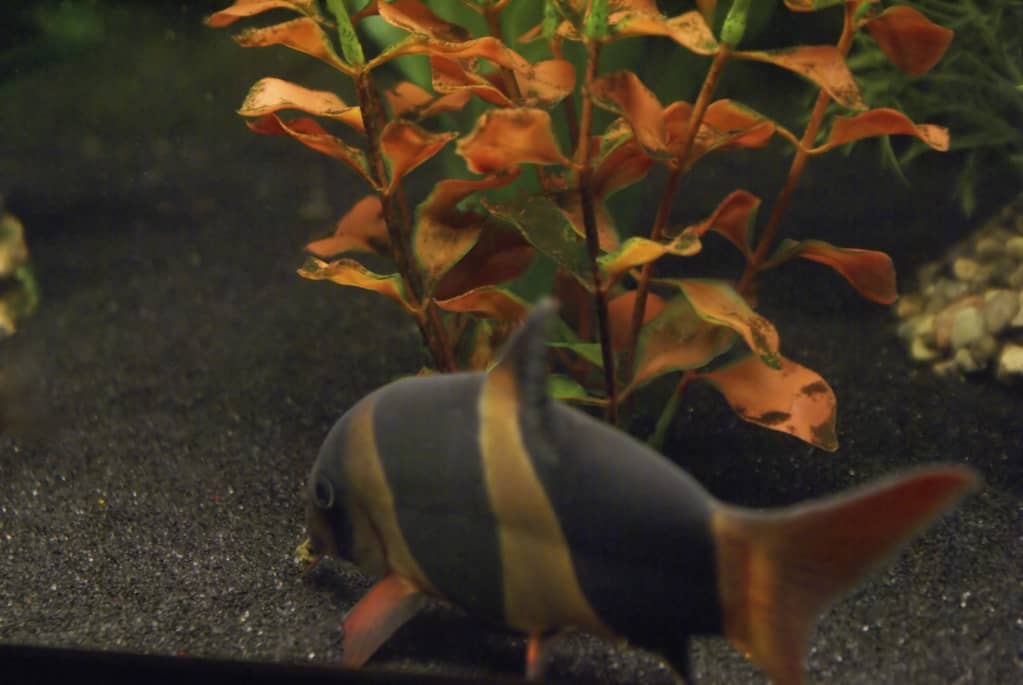
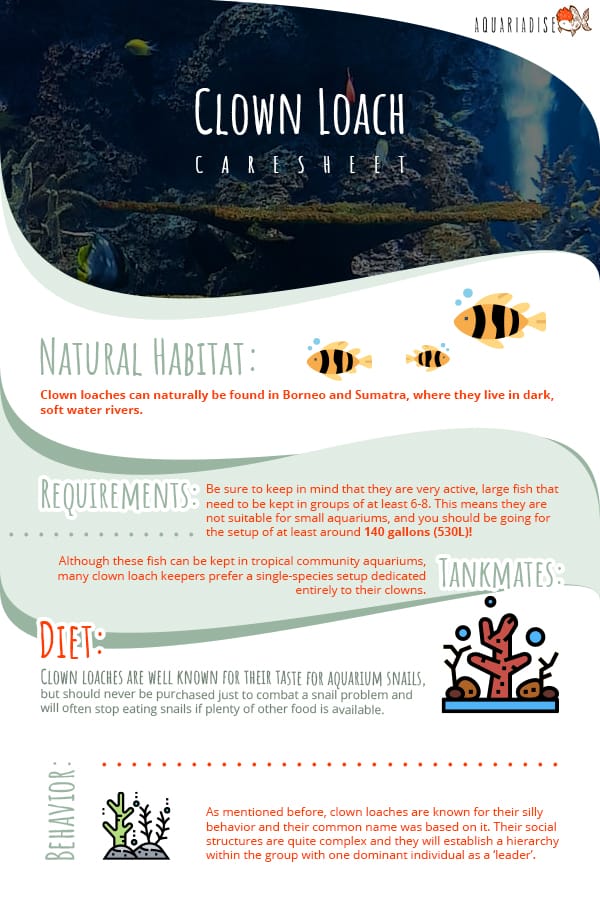
Those striking orange and black clown loaches at the fish store look like the perfect addition to your community tank — until you learn they grow over a foot long, need to live in groups of six or more, and require a 140-gallon aquarium minimum. Most clown loaches sold are juveniles under 3 inches, which is why they’re one of the most commonly mis-sold beginner fish in the hobby.
Quick Care Overview
Taxonomy and Common Names
Chromobotia macracanthus is commonly known as the clown loach or tiger botia. First described in 1852 by Pieter Bleeker as Cobitis macracanthus, the species was reclassified as Botia macracanthus by 1989. In 2004, Dr. Maurice Kottelat divided the Botia genus into seven separate genera, placing the clown loach into its own genus, Chromobotia.
Natural Habitat
Clown loaches are native to the Greater Sunda Islands of Borneo and Sumatra, spanning Indonesia and Malaysia. Their habitat varies seasonally: adults live in river channels with clear, flowing water most of the year, then migrate upstream to murkier floodplains during the wet season to breed. Juveniles remain in these vegetation-rich areas where detritus coverage provides food and protection.
[FACT] Nearly every clown loach sold in aquarium stores was wild-caught. Captive breeding is exceptionally rare because replicating their seasonal migration and breeding conditions is nearly impossible in home aquariums.
Identification
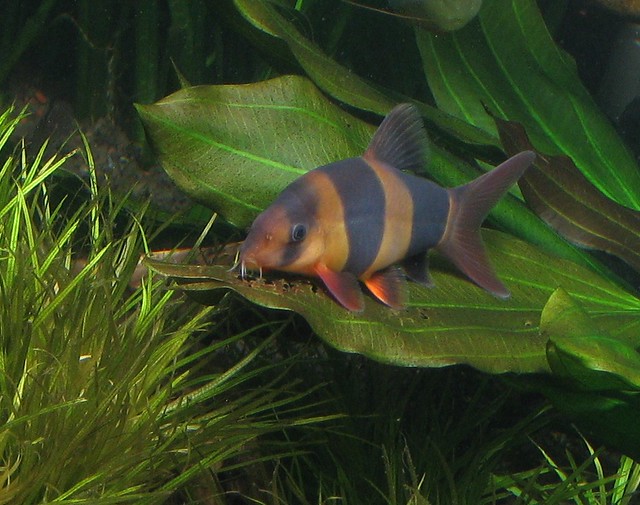
Clown loaches share the laterally compressed body shape of other Botia species like yo-yo and zebra loaches, but grow significantly larger at 8-12 inches (20-30 cm). Their forked tail and streamlined body allow for sudden, rapid movement along the riverbed. Four pairs of barbels help them sift through substrate and locate food.
Interestingly, Borneo and Sumatran populations differ enough that they may eventually be classified as separate species. Borneo clown loaches have blacker pelvic fins and pale borders on their bands, while Sumatran fish have redder pelvic fins with more defined banding.
Telling Males from Females
Clown loaches exhibit subtle sexual dimorphism. Females are typically plumper with a straight tail fin. Males have a visible inward curve to the tail.
Tank Requirements
The single most important factor in clown loach care is tank size. These are large, active, schooling fish that need space to thrive.
[WARNING] Size Matters
A 20-gallon tank is fine for juvenile clown loaches for perhaps a year — then you’ll need that 140+ gallon setup. Plan for adult size from day one, or don’t buy these fish.
Tank size: Minimum 140 gallons (530L) for a group of 6. Longer tanks are better than tall ones since clown loaches are bottom dwellers.
Substrate: Soft sand or fine gravel. Clown loaches dig and sift constantly — rough substrate can damage their barbels.
Lighting: Subdued. These fish come from shaded rainforest streams and prefer dimmer conditions.
Flow: Moderate to strong. They naturally inhabit rivers. If your filter doesn’t create adequate current, add an air pump or powerhead.
Plants: Heavy planting provides security, but choose hardy species. Clown loaches uproot and nibble on weaker plants. Anubias, Java fern, and other robust low-light plants work well.
Hiding spots: Essential. Provide caves, driftwood with crevices, and dense plant cover. These fish wedge themselves into surprisingly small spaces to rest.
Water Quality
Clown loaches have small scales, which makes them more vulnerable to disease and water quality issues than most aquarium fish.
- Only add them to fully cycled, established aquariums
- Maintain ammonia and nitrite at 0 ppm — they’re extremely sensitive to both
- Keep nitrates under 20 ppm with regular water changes
- pH of 6.0-7.5, with softer acidic water preferred
- Temperature: 78-87°F (25-30°C)
[TIP] Pro Tip
Keep ich medication on hand. Clown loaches are notoriously susceptible to white spot disease, often being the first fish in a tank to show symptoms. Catching it early is crucial.
Compatible Tankmates
Clown loaches work well with active tropical community fish that can handle their energy level:
Good tankmates:
- Tiger barbs, cherry barbs, and other active barbs
- Rainbowfish
- Other loaches (yo-yo, zebra, kuhli)
- Bristlenose plecos
- Larger tetras (Congo, Buenos Aires)
Avoid:
- Slow, long-finned fish (bettas, fancy guppies, angelfish) — may be stressed or nipped
- Calm, peaceful species that can’t compete for food
- Any invertebrates you want to keep alive — shrimp and snails are food, not friends
Many experienced keepers opt for a species-only tank, which simplifies care and lets you fully appreciate their social dynamics.
Diet
Clown loaches are omnivores with big appetites. In the wild, they eat worms, snails, small crustaceans, and plant matter.
Feed a varied diet including:
- Sinking pellets or shrimp pellets as a staple
- Bloodworms and earthworms (live or frozen)
- Brine shrimp
- Blanched vegetables (zucchini, cucumber, peas)
- Algae wafers
- Pest snails as occasional treats
[WARNING] Don’t Buy Them for Snail Control
Clown loaches eat snails enthusiastically — but they’ll clear out a snail population in weeks, then need decades more care. Never purchase these fish solely to solve a pest snail problem.

Behavior
Clown loaches are called “clown” loaches for good reason — they’re active, playful, and endlessly entertaining to watch.
They establish complex social hierarchies within their group, with a dominant leader. You may see them “fighting” or “dancing” — this is normal social behavior. They also make audible clicking sounds by grinding their teeth, which gets louder when they’re excited (usually at feeding time).
Did You Know?
Clown loaches often sleep in bizarre positions — upside down, wedged under rocks, lying completely on their sides. Many new owners panic thinking their fish is dead. It’s completely normal behavior.
Another common behavior is pacing — the group will swim rapidly back and forth, often in response to something entering the water (food, your hand, a new object). The exact reason is unknown, but it’s not a sign of stress.
Are Clown Loaches Aggressive?
No. While they’re boisterous and may chase each other during social interactions, they’re not aggressive toward other species. They can stress out slower tankmates simply through their activity level, not through aggression.
[FACT] Clown loaches have a sharp, retractable spine near their eye that they raise when stressed or threatened. This spine can pierce skin and easily snag in nets. Handle with care and avoid netting if possible — use a container instead.
Breeding
Breeding clown loaches in home aquariums is extremely rare. In the wild, they migrate seasonally to murky floodplains to spawn — conditions that are nearly impossible to replicate in captivity.
Even if spawning occurs in a display tank, eggs are typically eaten before fertilization, often by the parents themselves. Commercial breeding operations use hormone injections to induce spawning, which isn’t practical for hobbyists.
This is why virtually all clown loaches in the trade are wild-caught from Indonesia.
Should You Keep Clown Loaches?
Clown loaches are rewarding fish for keepers who can meet their demands:
- 140+ gallon tank (or plans to upgrade within a year)
- Commitment to keeping 6-8 fish together
- Excellent water quality maintenance
- 20+ year commitment — these fish can outlive dogs
If you have the space and dedication, few freshwater fish are as entertaining or personable. If you’re working with a smaller tank or shorter time horizon, consider other loaches like kuhlis or yo-yos instead.
Have questions about clown loach care? Share your experiences in the comments below.
Frequently Asked Questions
How big do clown loaches get?
Clown loaches grow 8-12 inches (20-30 cm) in aquariums, though wild specimens can reach 16 inches. Growth is slow — they may take 5-10 years to reach full size.
How long do clown loaches live?
With proper care, clown loaches live 20-25 years or more. Some have reportedly lived over 30 years. This is a serious long-term commitment.
Can I keep just one or two clown loaches?
No. Clown loaches are highly social fish that become stressed, reclusive, and may stop eating when kept in groups smaller than 5-6. They need their school to thrive.
Why is my clown loach lying on its side?
This is normal sleeping behavior. Clown loaches rest in unusual positions — sideways, upside down, or wedged into tight spaces. If the fish is active during feeding time and shows no other symptoms, it’s fine.
Will clown loaches eat all my snails?
Yes, clown loaches will eat pest snails, but they’ll also eat any snails you want to keep (nerites, mystery snails). Don’t buy clown loaches solely for snail control — they’re a 20+ year commitment that far outlasts any snail problem.