

Quick Answer
Remove bubble algae by twisting individual bubbles off at the base with a sharpened screwdriver while running a siphon nearby to catch any released spores. Never pop the bubbles — each one contains thousands of spores that will colonize your entire tank.
You spot a few glistening green spheres on your live rock. They look almost pretty — like tiny glass marbles. Within a month, those few bubbles have become dozens. Within three months, they’re spreading across your rockwork faster than you can remove them.
That’s the trajectory of bubble algae (Valonia ventricosa) in most reef tanks. The problem isn’t that it’s toxic or that it harms coral directly. The problem is that most hobbyists make the outbreak worse by removing it incorrectly.
What Makes Bubble Algae Different From Other Pest Algae
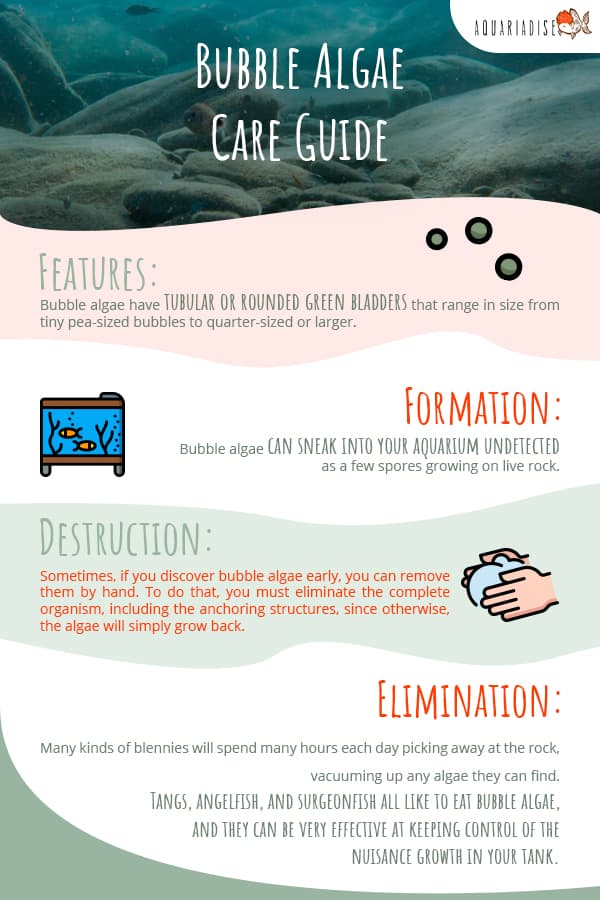
Each bubble is a single cell — one of the largest single-celled organisms on Earth. That glossy green sphere sitting on your rock can grow up to 5 cm in diameter, and every millimeter of that is one enormous cell wall containing thousands of reproductive spores.
This is why the “just scrub it off” advice you’ll see on reef forums is the worst possible approach. Pop one bubble and you’ve released a cloud of spores into your water column. Those spores settle on every surface in your tank within 24 hours.
[WARNING] The Mistake That Makes Everything Worse
Popping bubble algae underwater is like blowing dandelion seeds indoors. Each ruptured bubble releases spores that will establish new colonies across your entire tank. This is how a minor annoyance becomes a full infestation.
Identifying the Species in Your Tank
Not all bubble algae behave the same way. Knowing what you’re dealing with helps you gauge how aggressive your removal strategy needs to be.
| Species | Appearance | Behavior |
|---|---|---|
| Valonia ventricosa | Large single bubbles, deep emerald green | Most common in tanks; grows singly or in loose clusters |
| Valonia macrophysa | Dense clusters of smaller, elongated bubbles | Spreads faster than single-bubble species |
| Dictosphaeria cavernosa | Pitted, irregular bubbles; pale green | Forms mats rather than individual spheres; harder to remove |
| Boergesenia | Elongated tubes in loose clusters | Less aggressive than Valonia species |
Red bubble algae (Botryocladia) sometimes appears alongside green varieties. It’s less common and typically less aggressive, but the removal approach is identical.
How It Gets Into Your Tank
Bubble algae doesn’t spontaneously generate. It hitches a ride — almost always on live rock, coral frags, or the plugs and disks corals are mounted on.
The frustrating part: you can’t always see it. Spores are microscopic. A piece of live rock can look perfectly clean and still be carrying enough spores to seed an outbreak.
[TIP] Pro Tip
Quarantine live rock in a separate container with saltwater for 2-3 weeks before adding it to your display tank. Any dormant spores will germinate into visible bubbles during this time, letting you remove them before they ever enter your main system.
When inspecting new rock, feel underneath and behind surfaces — bubble algae thrives in surprisingly low-light areas. I’ve seen infestations that started entirely on the back side of rockwork where the hobbyist never thought to look.
The Correct Manual Removal Technique
Manual removal is the most effective method for existing infestations — but only if you do it right.
[FACT] Remove bubbles before they exceed 5mm in diameter. Larger bubbles are more likely to rupture during removal and contain exponentially more spores.
Biological Control: What Actually Works
The emerald crab (Mithraculus sculptus) is the go-to recommendation for bubble algae control, and it’s earned that reputation — with caveats.
Emerald crabs will eat bubble algae, but they’re opportunistic omnivores. In tanks with plentiful prepared foods, they may ignore the algae entirely. In tanks where they’re slightly underfed, they’re more motivated. The trade-off: hungry emerald crabs have been known to pick at coral polyps and harass small fish.
Other biological options:
- Turbo snails — Useful for preventing new colonies from establishing, but won’t eliminate an existing outbreak
- Certain sea urchins — Effective grazers, but their spines and bulldozing behavior can damage coral placement
- Tangs, angelfish, and blennies — Some individuals pick at bubble algae; others ignore it completely. Species-level recommendations are unreliable because individual fish vary
Did You Know?
Sea hares are voracious bubble algae consumers, but they’re a short-term solution with a nasty downside. Once they’ve eaten all available algae, they starve and die — and a dying sea hare can release ink that crashes your tank chemistry.
The real limitation of biological control: every creature that eats bubble algae risks rupturing the vesicles, potentially spreading spores. Biological control works best as prevention after you’ve manually removed the bulk of an infestation.
Nutrient Control: The Long-Term Strategy
Bubble algae, like all algae, needs nitrates and phosphates to grow. Starve it of these, and you limit its ability to spread even if spores are present.
Target parameters:
- Nitrates: As close to 0 ppm as possible
- Phosphates: Undetectable (below 0.03 ppm)
Achieving this requires a combination of approaches:
- Weekly partial water changes with RO/DI water
- Running a protein skimmer
- Using a phosphate reactor (GFO media)
- Competing macroalgae in a refugium — Chaetomorpha is the standard choice
Introducing desirable macroalgae creates direct competition for the same nutrients bubble algae needs. Coralline algae is particularly effective — it forms a crust over rock surfaces that physically blocks bubble algae from establishing holdfasts. [INTERNAL LINK: “reef tank water parameters” -> water chemistry guide]
Frequently Asked Questions
Is bubble algae harmful to coral?
Bubble algae doesn’t directly poison or attack coral. The harm is competitive — dense growth can shade coral, block water flow, and eventually overgrow slower-growing species. In severe infestations, the algae physically crowds out coral by occupying all available surface area.
Will bubble algae go away on its own?
No. Bubble algae won’t disappear without intervention. Even in nutrient-poor conditions, established colonies persist and continue producing spores. You need active removal combined with nutrient control to eliminate it.
Can I use chemicals to kill bubble algae?
No chemical treatment effectively kills bubble algae without harming your tank inhabitants. Products marketed as algae killers target different algae types and won’t penetrate the thick cell wall of Valonia species. Manual removal remains the only reliable approach.
How many emerald crabs do I need for bubble algae control?
One emerald crab per 20-25 gallons is a reasonable starting point for prevention. For active infestations, increase to one per 10-15 gallons temporarily, but remove excess crabs once the algae is controlled — overcrowded emerald crabs become more likely to damage coral.
I popped a bubble by accident. Is my tank ruined?
Not ruined, but expect new growth in 2-4 weeks. Immediately siphon the area where the bubble ruptured. Run carbon filtration for 24 hours. Watch for new bubbles and remove them while they’re still tiny — small bubbles are easier to remove intact and contain fewer spores.
The reality of bubble algae is that complete eradication is difficult. Most reef keepers who’ve dealt with it learn to manage it — removing new growth during regular maintenance before it becomes overwhelming. A few small bubbles in low-visibility areas aren’t worth obsessing over. An expanding colony taking over your rockwork requires immediate action. Know the difference, and you’ll keep this pest algae from ever becoming a real problem. [INTERNAL LINK: “reef tank maintenance” -> maintenance schedule guide]


