

You’ve seen Boesemani and Turquoise Rainbows in every fish store. But Melanotaenia fluviatilis—the Australian Rainbowfish—rarely makes it onto the sales floor. That’s a shame, because this Murray River native is one of the most adaptable rainbows you can keep, tolerating parameter swings that would stress most of its flashier cousins.
Quick Answer
Australian Rainbowfish are hardy, peaceful schoolers that thrive in 30+ gallon tanks with good flow. They tolerate pH from 6.5-8.5 and temperatures from 70-79°F. Keep them in groups of 6+ with more females than males to prevent aggression and bring out their best color.

Species Overview
Melanotaenia fluviatilis, also called the Crimson-spotted Rainbowfish, Murray River Rainbowfish, or Inland Rainbowfish, was first described by Castelnau in 1878. In the wild, they inhabit streams, rivers, swamps, and slow-moving ditches across southeastern Australia where vegetation grows thick and water stays relatively clear.
These omnivores school under floating plants and submerged logs, picking off small crustaceans and insects. While not currently IUCN-listed, wild populations have declined sharply following winter droughts—another reason captive-bred specimens matter.
Quick Care Overview
Appearance and Color Development
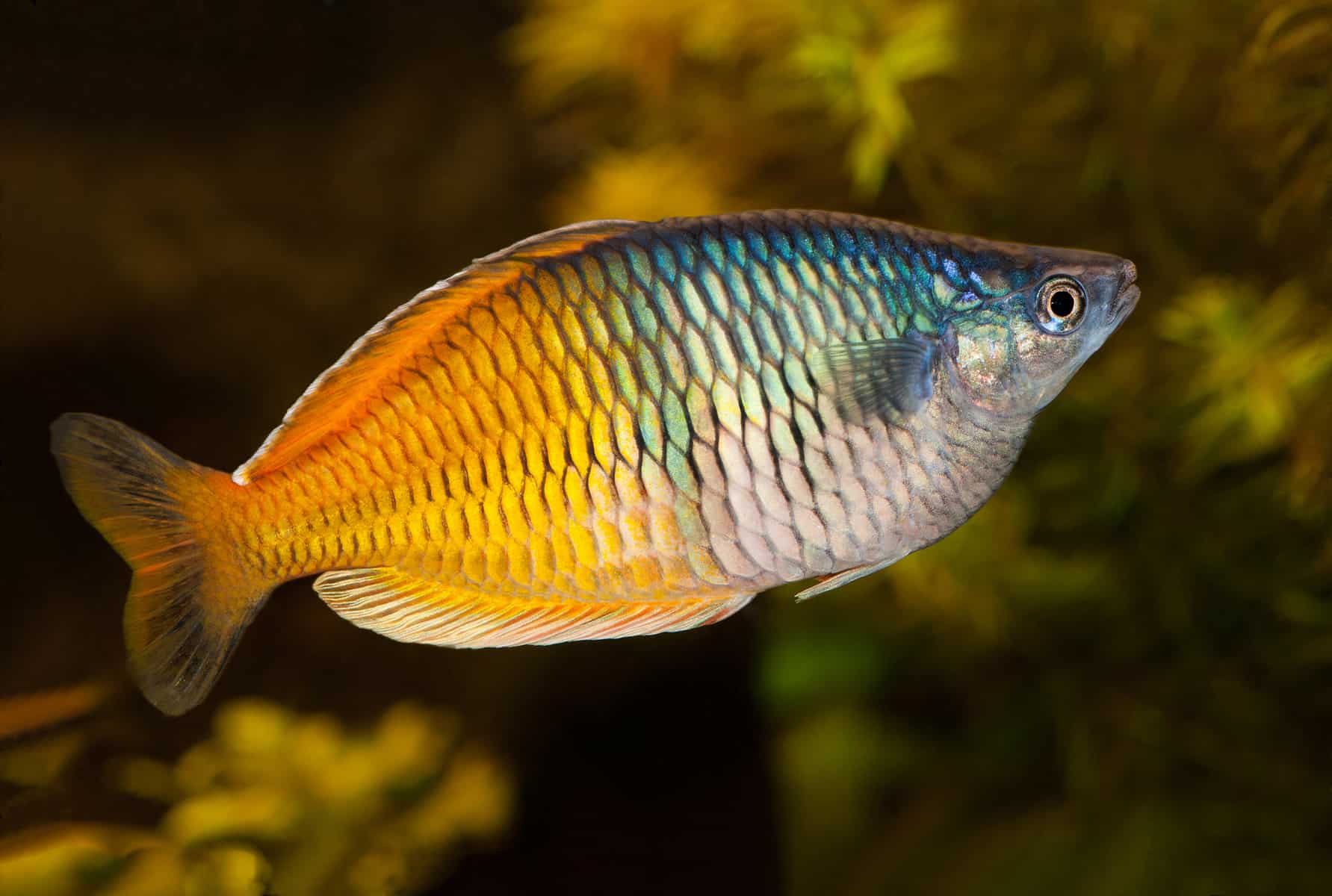
Australian Rainbowfish have a slender, compressed body with an arched back and distinctively large eyes. Males are the lookers: olive-green to bluish-brown base coloration with a dark horizontal stripe along the midline, rows of metallic green and turquoise scales, and a rosy pink belly. The fins show reddish hues, often outlined in black during breeding condition.
When males are ready to spawn, their colors intensify dramatically—that emerald green flash during morning display is why hobbyists call them “the wake-up call fish.”
Females stay more subdued in coloration and run slightly smaller. Here’s what most care guides don’t mention: coloration in this species varies significantly by river system of origin. Fish from different Murray-Darling tributaries can look like different species entirely. If color consistency matters to you, buy fish from the same source.
[TIP] Pro Tip
Australian Rainbowfish often arrive at your tank looking washed out. Don’t panic. It can take 2-3 months for them to settle in and show their true colors. Good diet, stable parameters, and the presence of rival males accelerates this process significantly.
Tank Setup
Tank Size and Cover
Minimum 30 gallons for a school, but 40+ gallons lets them really stretch out. These are active swimmers—they need horizontal space more than height. A 36-inch tank length is ideal.
Critical detail that generic guides bury: Australian Rainbowfish are jumpers. Not occasional jumpers—committed jumpers. A tight-fitting lid with no gaps is mandatory. I’ve lost M. fluviatilis through openings I’d have sworn were too small. If there’s a gap around filter intakes or heater cords, plug it.
Water Parameters
This is where M. fluviatilis shines. They handle pH from 6.5 to 8.5, hardness from 8 to 25 dGH, and temperatures from 70 to 79°F. That’s an enormous range. If you have hard, alkaline tap water that makes most tropical fish miserable, Australian Rainbows will thrive in it straight from the faucet.
They school in the middle and upper water column, so surface agitation matters. Good flow brings out male coloration—stagnant water produces dull fish.
Substrate and Decor
Sand or fine gravel works well. Add driftwood and dense planting along the back and sides, leaving the center open for swimming. This mimics their natural habitat of vegetated riverbanks opening into clear channels.
One setup trick: position the tank where it gets an hour or two of indirect sunlight. Morning light hitting a tank of displaying male rainbows is genuinely spectacular—colors you won’t see under standard aquarium lighting alone. [INTERNAL LINK: “planted tank lighting” -> best aquarium lights]
Plant selection note: choose species that tolerate harder, more alkaline water. Vallisneria, Java Fern, Anubias, and most Cryptocorynes work well. Soft-water plants like Rotala may struggle in the conditions M. fluviatilis prefers.
Gender Ratios: The Part Most Guides Get Wrong
Generic advice says “keep more females than males.” That’s true but incomplete. The specific ratio matters, and it changes with group size.
Here’s what actually works:
| School Size | Males | Females | Notes |
|---|---|---|---|
| 5 fish | All one sex | All one sex | Don’t mix at this size |
| 6 fish | 3 | 3 | Minimum mixed group |
| 7 fish | 3 | 4 | — |
| 8 fish | 3 | 5 | — |
| 9 fish | 4 | 5 | — |
| 10+ fish | Equal or slight female majority | — | More flexibility at larger sizes |
Why five fish shouldn’t be mixed: in small groups, a single dominant male can harass females relentlessly while subdominant males get no color development at all. Either go all-male (for color) or all-female (for peace), or commit to six or more.
Tankmates
Australian Rainbowfish work well in community setups, especially alongside other rainbows. They’re peaceful but active—and that activity level is the compatibility issue most people miss.
M. fluviatilis are fast, constant swimmers. Slow-moving fish like fancy guppies or long-finned bettas get stressed trying to keep up or get out of the way. Shy bottom-dwellers like Corydoras generally ignore them and vice versa, which works fine.
Good tankmates: other Melanotaeniids, larger tetras (Congo, Buenos Aires), barbs, larger rasboras, peaceful cichlids like keyholes or Bolivian rams, and Corydoras.
Avoid: anything slow-moving with flowing fins, tiny shrimp (adult Amanos are usually fine, but cherry shrimp juveniles will become snacks), and small snails.
[WARNING] Hybridization Risk
All Melanotaeniidae will interbreed in captivity, even though they don’t in the wild. If you keep multiple rainbow species and any spawning occurs, the resulting fry lose the distinctive coloration of both parents. Keep species separate if you’re breeding, or accept that any fry will be hybrids.
Diet
Omnivores in the wild, eating insects, small crustaceans, and plant matter. In the aquarium, a quality flake or small pellet should form about 75% of their diet. The remaining 25% should include frozen or live foods: brine shrimp, daphnia, bloodworms, and white worms.
Feed two to three times daily, only what they’ll consume in 2-3 minutes. Overfeeding rainbows leads to bloat faster than with many other species—their digestive systems seem less forgiving of excess.
Color-enhancing foods with astaxanthin or spirulina genuinely help bring out the reds and greens. This isn’t marketing—you’ll see the difference within a few weeks. [INTERNAL LINK: “best fish foods for color” -> color enhancing fish food]
Breeding Australian Rainbowfish
M. fluviatilis breeds readily in captivity with some preparation.
The hard part isn’t getting them to spawn—it’s raising the fry. Rainbowfish fry grow painfully slowly for the first two months and are sensitive to water quality fluctuations during this period. Keep the rearing tank scrupulously clean with small, frequent water changes rather than large infrequent ones.
Common Health Issues
Australian Rainbowfish are hardy when conditions are right. Most health problems trace back to poor water quality or stress from incorrect stocking. Quarantine new fish for at least a week before adding them to an established tank. [INTERNAL LINK: “quarantine tank setup” -> quarantine tank]
Ich (White Spot Disease)
Caused by Ichthyophthirius multifiliis, a parasite present in most aquariums that becomes problematic when fish are stressed. Look for white specks across the body and fins, plus flashing behavior (rubbing against surfaces).
Treatment: Raise temperature to 82-86°F and dose with a copper-based or malachite green medication per package instructions. The elevated temperature speeds up the parasite’s lifecycle, making treatment more effective.
Velvet (Gold Dust Disease)
Caused by Oödinium parasites. Symptoms include a dusty gold or rust-colored film on the skin, clamped fins, lethargy, and rapid gill movement. Fish flash against objects trying to remove the parasites.
Treatment: Dim or eliminate lighting (these parasites contain chlorophyll and need light), raise temperature to 82°F, and treat with copper sulfate for 10 days minimum. Don’t stop treatment early—Velvet is harder to eradicate than Ich.
Where to Buy
Australian Rainbowfish rarely appear in chain pet stores. Your best options are specialty aquarium shops, aquarium society auctions, or online vendors. Expect to pay $8-15 per fish depending on size and source.
When buying, look for active fish with clear eyes and no clamped fins. Avoid the largest specimens in a batch—bigger often means older, and you want fish with most of their lifespan ahead of them. Juveniles may look washed out, but healthy ones color up beautifully once settled.
Frequently Asked Questions
How big do Australian Rainbowfish get?
Adults reach about 4 inches (10 cm) in length. Males grow slightly larger than females and develop more intense coloration.
Are Australian Rainbowfish aggressive?
No. They’re peaceful schooling fish. Males display to each other and may chase occasionally, but actual aggression is rare. Problems usually stem from incorrect gender ratios or keeping them with fish that can’t handle their activity level.
Can Australian Rainbowfish live with shrimp?
Adult Amano shrimp are usually safe. Smaller species like cherry shrimp will likely become food, especially juveniles. If you want a shrimp colony to thrive, keep them in a separate tank.
Why are my Australian Rainbowfish pale?
New fish need 2-3 months to show full color. If established fish fade, check water quality, ensure adequate flow, and add rival males—competition brings out color. Diet matters too; foods with astaxanthin or spirulina help.
How many Australian Rainbowfish should I keep together?
Minimum of 6 for a mixed-gender group. If keeping only 5, stick to a single sex. More is better—larger schools display more confidently and show better color.


