
? Key Takeaways
- They Have Special Vision Needs: Unlike standard Cherry Barbs, albinos often have poorer eyesight. You must ensure they aren’t outcompeted for food during feeding time.
- Lighting Matters: The lack of melanin makes their eyes sensitive to bright lights. Floating plants and dimmable LEDs are essential to reduce stress.
- Schooling is Mandatory: These are not solitary fish. You need a group of at least 6 to prevent skittish behavior and aggression.
- Tank Size Reality: While older guides say 10 gallons, a proper school of active adults needs a 20-gallon Long aquarium to thrive.
The Albino Cherry Barb (Puntius titteya) is a striking, pink-hued variant of the classic aquarium staple. While they share the peaceful temperament and hardiness of their red cousins, the Albino variant brings a unique “ghostly” aesthetic to planted tanks.
However, keeping albinos isn’t exactly the same as keeping the standard variety. Their lack of pigmentation affects their eyesight and sensitivity to light, meaning you have to adjust your tank setup slightly to keep them comfortable.
In this guide, we move beyond the basic textbook care. We’ll cover exactly how to manage their light sensitivity, why they might be missing their food, and how to make their unique pink coloration pop against your aquascape.
Albino Cherry Barb: At A Glance
| Scientific Name | Puntius titteya (Albino variant) |
| Care Level | Easy / Beginner Friendly |
| Adult Size | 1.5 – 2 inches (5 cm) |
| Lifespan | 4–5 years (with proper care) |
| Minimum Tank Size | 20 Gallons (for a school of 6) |
| Temperature | 73° – 79°F (23° – 26°C) |
| pH Range | 6.0 – 7.5 |
| Diet | Omnivore (Watch for slow feeding response) |
| Temperament | Peaceful Schooling Fish |
The “Albino” Difference: What You Need to Know
Before we dive into water parameters, it is vital to understand what makes this fish different from the standard Red Cherry Barb. Albinism is a genetic condition characterized by a lack of melanin (pigment).
This impacts the fish in two specific ways:
- Photosensitivity: Without protective pigment in their eyes, Albino Cherry Barbs are sensitive to intense aquarium lighting. In our experience, if you blast them with high-output LEDs without shade, they will spend their lives hiding in the back corners.
- Visual Acuity: Albino fish generally have poorer depth perception than their pigmented counterparts. You might notice them lunging at food and missing it on the first try. This isn’t a disease; it’s just their genetics.
Origins and Natural Habitat
The standard Cherry Barb hails from the shaded, slow-moving streams of Sri Lanka. They thrive in shallow waters with silty bottoms, surrounded by leaf litter and overhanging vegetation.
However, you won’t find the Albino Cherry Barb in the wild. This variant is purely a product of captive breeding within the aquarium hobby. While they don’t exist in Sri Lankan streams, their biological needs still mimic that environment: warm, soft water with plenty of cover.
Note on Conservation: While the wild Puntius titteya is listed as Vulnerable on the IUCN Red List due to habitat loss, the Albino barbs you buy at your Local Fish Store (LFS) are commercially farmed and sustainable.
Appearance and Size
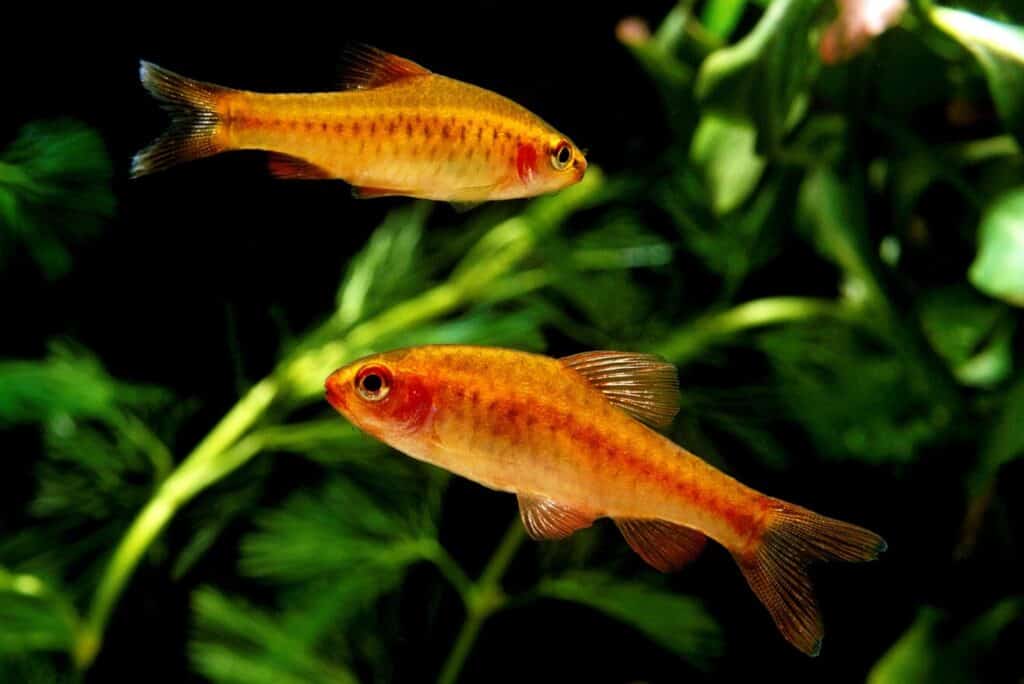
Instead of the deep maroon or bright cherry red of the wild type, the Albino sports a creamy, pale-pink body. The characteristic horizontal lateral line is still present but appears as a faint, slightly metallic pink-to-white stripe rather than black.
The Eyes: The most giveaway trait is the eyes. They will be a distinct pink or bright red. If the fish is pale but has black eyes, it is likely a “Leucistic” or “Gold” variant, not a true Albino.
Growth Expectations
These are nano-friendly fish, maxing out at around 2 inches (5 cm). Females tend to be slightly plumper and larger, while males are more slender and often display a deeper pink hue when in “breeding mode.”
Behavior and Temperament
The Albino Cherry Barb is one of the most peaceful barbs in the hobby. Unlike Tiger Barbs, which are notorious fin-nippers, Cherry Barbs are generally safe to keep with long-finned fish like Bettas or Guppies.
The Importance of Schooling
We cannot stress this enough: You must keep them in groups.
A solo Cherry Barb is a stressed fish. It will lose its color, hide constantly, and its immune system will weaken. In our tanks, we see the best behavior in groups of 6 to 8 fish. In a group, the males will display fascinating “sparring” dances—flaring their fins to show off for females—without actually hurting each other.
Tank Requirements & Setup
While older literature often cites 10 gallons as the minimum, we strongly advise against this for a long-term home. These fish are active swimmers.
Tank Size
- Minimum: 20-gallon Long (allows for proper horizontal swimming space).
- Ideal: 29-gallon or larger community tank.
Lighting and Decor (Crucial for Albinos)
Because of their light sensitivity, your aquascape needs to provide “sunglasses” for your fish.
- Substrate: Use a dark sand or gravel. This reduces light reflection from the bottom and makes the pale pink color of the fish pop significantly better than white sand.
- Plants: Dense vegetation is a must. Use tall stem plants like Limnophila sessiliflora or Vallisneria.
- The “Secret Weapon”: Floating plants. Adding Frogbit or Red Root Floaters creates dappled shade, mimicking their ancestral streams and making the albinos feel secure enough to swim in the open.
Water Parameters
Albino Cherry Barbs are hardy, but they dislike rapid changes. Stability is more important than chasing “perfect” numbers.
- Temperature: 73° – 79°F (23° – 26°C).
- pH: 6.0 – 7.5 (slightly acidic to neutral is best).
- Hardness: 4 – 15 dGH.
- Flow: Low to Moderate. They are not built for rapids; a gentle current is ideal.
Diet and Feeding Strategy
Feeding is where many beginners accidentally neglect their Albino Cherry Barbs. Because their vision is poorer, they may be outcompeted by faster fish like Danios or Tetras.
What to feed:
- High-quality flakes/pellets: Look for color-enhancing foods rich in carotenoids to help bring out their pink tones.
- Frozen Foods: Daphnia, Baby Brine Shrimp, and Bloodworms.
- Live Foods: These are excellent for triggering their hunting instinct.
Pro Tip: If you notice your Albinos missing the food, try using sinking pellets dropped into the same corner of the tank every day. They will learn the scent and location, ensuring they get a full meal.
Tank Mates
Albino Cherry Barbs are the perfect citizens for a peaceful community tank. They occupy the middle and bottom layers of the water column.
Excellent Roommates:
- Bottom Dwellers: Corydoras Catfish and Kuhli Loaches.
- Mid-to-Top Dwellers: Harlequin Rasboras, Neon Tetras, and Honey Gouramis.
- Invertebrates: Amano Shrimp and Mystery Snails. (Note: They may eat tiny baby shrimp, but adults are usually safe).
Avoid These Fish:
Do not pair them with large, aggressive Cichlids (Oscars, Jack Dempseys) or boisterous fin-nippers like large Tiger Barbs, as the slower-reacting Albinos will become easy targets.
Breeding: The Genetics of Pink
Breeding Albino Cherry Barbs is moderately easy and a great project for intermediate hobbyists. They are egg scatterers that show no parental care.
The Genetic Twist
If you breed an Albino male with an Albino female, you will get 100% Albino fry. However, if you breed an Albino with a regular Red Cherry Barb, the offspring will likely all look strictly red (carrying the recessive albino gene), unless the red parent also carries the gene.
The Breeding Setup
- Conditioning: Feed the pair live foods or high-protein frozen foods for 7-10 days.
- Spawning Tank: Use a 5 or 10-gallon tank with a sponge filter. Fill the bottom with Java Moss or a spawning mop.
- The Act: Introduce the pair in the evening. Spawning usually happens the next morning. The male will chase the female, and she will scatter eggs into the moss.
- Removal: Remove the adults immediately after spawning, or they will eat the eggs.
- Fry Care: Eggs hatch in 24-48 hours. Once free-swimming (about 3 days later), feed them infusoria or vinegar eels until they are large enough for baby brine shrimp.
Health and Disease
While robust, the Albino variant can be slightly more delicate regarding skin issues because they lack pigment protection.
Common Issues:
- Ich (White Spot): Looks like salt grains. Treat by raising the temperature slowly to 86°F. Caution: Albinos can be sensitive to copper-based medications. Always start with a half-dose.
- Fin Rot: Usually caused by poor water quality. The best cure is clean water and regular maintenance.
Preventive Care
Perform a 20-25% water change weekly. Vacuum the gravel to remove waste, but be gentle around plants. Because albinos are harder to spot against white fungal infections (since the fish is already pale), observe their behavior closely. Clamped fins are usually the first sign of trouble.
Frequently Asked Questions
Are Albino Cherry Barbs rare?
No, they are quite common in the aquarium trade now. Most well-stocked Local Fish Stores (LFS) or major chain pet stores carry them regularly.
Can Albino Cherry Barbs school with regular Cherry Barbs?
Yes! They are the same species and will readily school together. Mixing red and albino varieties creates a beautiful contrast in a planted tank.
Do Albino Cherry Barbs eat algae?
They will peck at algae, but they are not efficient cleaners like Otocinclus or Plecos. Do not rely on them to solve an algae problem in your tank.
Why is my Albino Cherry Barb turning white?
If they lose their pink hue and turn stark white, it is usually a sign of stress, poor water quality, or fear. Check your ammonia levels and ensure they have enough hiding spots.


