Key Takeaways
- Aggression varies by type: Some fish are “nippers” (Tiger Barbs), while others are territorial “tank busters” (Wolf Cichlids) or pure predators (Aimara).
- Tank size is the #1 aggression curb: Undersized tanks increase stress and territorial battles. Always over-filter and over-size for aggressive species.
- The “Odd Number” Rule: For shoaling aggressive fish (like Barbs or Tetras), keeping larger groups (6-12+) diffuses bullying within the school rather than onto tank mates.
- Know the law: Species like Snakeheads are invasive and illegal to own in many US states. Always check local regulations before buying.
You might initially shy away from keeping aggressive freshwater fish, assuming they are “problem” pets. But here is the reality we see at the fish store every day: some of the feistiest fish are also the most intelligent, interactive, and rewarding species to keep.
The term “aggressive” is a broad bucket. It ranges from the Tiger Barb (who just wants to nip fins) to the Wolf Cichlid (who wants to dismantle its tank mates). Understanding why a fish is aggressive—whether it’s breeding defense, feeding instinct, or pure territorial dominance—is the key to a peaceful home aquarium.
In this guide, we’ve upgraded our list for November 2025 to include not just the monsters, but the common community aggressors you need to watch out for. Here are the 12 aggressive species that—with the right care—we absolutely recommend.
1. Tiger Barb (Puntigrus tetrazona)
| Care Level | Beginner |
| Aggression Type | Fin-nipping / Schooling hierarchy |
| Min Tank Size | 30 Gallons |
| Water Temp | 75° – 80°F |
Tiger Barbs have a reputation for being schoolyard bullies, and frankly, they earn it. They are notorious fin-nippers that will harass slow-moving, long-finned fish (like Angelfish or Bettas) to death.
However, in our experience, aggression in Tiger Barbs is almost always a result of keeping too few of them. These are shoaling fish that establish a strict pecking order. If you keep a group of 3 or 4, they turn their energy outward toward other tank mates. If you keep a school of 10 or 12, they become so busy chasing each other to establish dominance that they largely ignore other fish.
? Pro Tip: Never keep Tiger Barbs with slow swimmers. Their best tank mates are other fast, semi-aggressive species like the Red Tail Shark or Clown Loaches.
2. Red Tail Shark (Epalzeorhynchos bicolor)
| Care Level | Intermediate |
| Aggression Type | Territorial (Bottom Dweller) |
| Min Tank Size | 55 Gallons |
| Water Temp | 72° – 79°F |
Often sold as a “community scavenger,” the Red Tail Shark is a classic case of mistaken identity. As juveniles, they are shy. As adults, they become fiercely territorial over “their” cave or driftwood.
The golden rule with Red Tail Sharks is one per tank. We have seen countless tanks crash because an owner tried to keep two of these sharks together; they will fight until the weaker one dies. They will also bully other bottom dwellers like Corydoras. However, they generally ignore fish that stay in the middle or top of the water column, making them excellent additions to semi-aggressive community tanks.
3. Dwarf Pufferfish (Carinotetraodon travancoricus)
| Care Level | Intermediate |
| Aggression Type | Territorial / Nipping |
| Min Tank Size | 10 Gallons (Species Only) |
| Water Temp | 72° – 82°F |
Don’t let their adorable, wide-eyed look fool you. The Dwarf (or Pea) Puffer is a tiny murder machine. We often call them “helicopters of hate” because of how they hover and inspect everything before biting it.
These are strictly species-only fish. If you put a Dwarf Puffer in a community tank, you will wake up to find your other fish with circular chunks missing from their fins. Crucially, they are molluscivores. If you have a pest snail problem, one Dwarf Puffer will clear a 20-gallon tank in a week. Just be prepared to feed them frozen bloodworms or live snails once the pests are gone, as they rarely accept flake food.
4. Bucktooth Tetra (Exodon paradoxus)
| Care Level | Intermediate |
| Aggression Type | Lepidophagy (Scale Eating) |
| Min Tank Size | 55 Gallons |
| Water Temp | 72° – 82°F |
The Bucktooth Tetra is not aggressive because it hates other fish; it’s aggressive because it wants to eat them—specifically their scales. This behavior, known as lepidophagy, makes them a nightmare for community tanks.
In the wild, they swarm larger fish to rip off scales. In your tank, they will strip a Goldfish or Silver Dollar naked. The only safe way to keep Bucktooth Tetras is in a large, single-species school of at least 12. In a large group, the aggression is dispersed, and you get to witness their incredible frenzied feeding behavior without risking other pets.
5. Jack Dempsey (Rocio octofasciata)
| Care Level | Intermediate |
| Aggression Type | Territorial |
| Min Tank Size | 55 Gallons |
| Water Temp | 72° – 86°F |
Named after the famous 1920s heavyweight boxer, the Jack Dempsey is a staple in the aggressive fish keeping hobby. While they look grueling, they are actually one of the more “manageable” large cichlids compared to Devils or Dovii.
Jack Dempseys are ambush predators that claim a territory (usually a cave) and defend it vigorously. They tend to be fine with other cichlids of similar size and temperament (like Green Terrors or Convict Cichlids), provided the tank is large enough (75+ gallons for a community). However, never keep them with small tetras or peaceful community fish—they will become an expensive snack.
6. Flowerhorn Cichlid (Paraneetroplus synspilus hybrid)
| Care Level | Easy/Intermediate |
| Aggression Type | Hyper-Territorial / Interaction |
| Min Tank Size | 75 Gallons (Solo) |
| Water Temp | 80° – 89°F |
The Flowerhorn Cichlid is the ultimate “Wet Pet.” This man-made hybrid is famous for its nuchal hump (the Kok) and its dog-like personality. They will follow your finger, beg for food, and even let you pet them (carefully).
However, that personality comes with a price: they generally hate roommates. A Flowerhorn will usually kill anything else in the tank, including plecos and snails. We strongly recommend keeping them solitary. They require pristine water and high temperatures to digest their food properly and maintain that vibrant color.
7. Wolf Cichlid (Parachromis dovii)
| Care Level | Advanced |
| Aggression Type | Predatory / Total Dominance |
| Min Tank Size | 150+ Gallons |
| Water Temp | 75° – 82°F |
If the Jack Dempsey is a boxer, the Wolf Cichlid (or “Dovii”) is a tank with fins. Growing up to 28 inches, this is arguably the most aggressive cichlid in the hobby.
This is not a fish for beginners. The Dovii has teeth, they use them, and they will attack the glass if you walk by. During breeding, their aggression spikes to levels where they will kill tank mates they have lived with for years. In our experience, a male Dovii requires a massive custom setup and should almost always be kept alone unless you have a tank approaching 300 gallons.
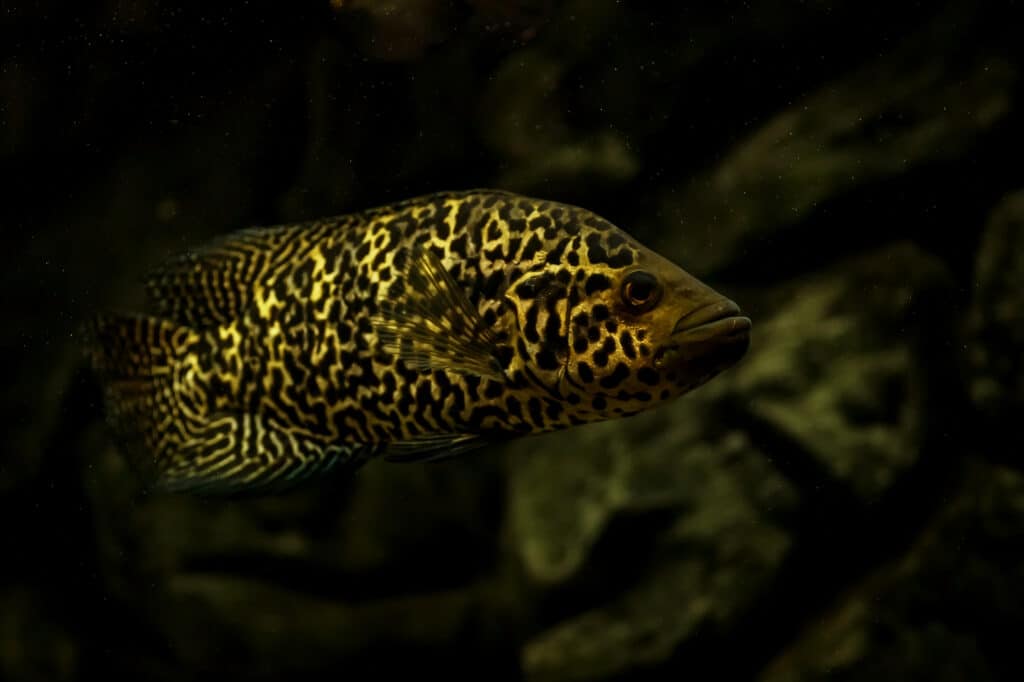
8. Jaguar Cichlid (Parachromis managuensis)
| Care Level | Intermediate/Advanced |
| Aggression Type | Predatory |
| Min Tank Size | 125 Gallons |
| Water Temp | 73° – 82°F |
The Jaguar Cichlid is a stunning predator with a creamy-yellow body and black “jaguar” spots. While slightly less psychotic than the Wolf Cichlid, the Jaguar is a dedicated hunter.
They are excellent parents but terrible neighbors. If you plan to breed them, remove all other fish; a breeding pair of Jaguars will claim the entire tank and eliminate threats. For a single specimen, they can sometimes coexist with other large, tough Central American cichlids (like Oscars or Red Devils) in a 180+ gallon tank, but monitor them closely.
9. Red-Bellied Piranha (Pygocentrus nattereri)
| Care Level | Intermediate |
| Aggression Type | Opportunistic Shoaling |
| Min Tank Size | 100 Gallons |
| Water Temp | 75° – 82°F |
Movies have given the Piranha a reputation as a mindless eating machine. In reality, Piranhas are actually quite skittish. Their aggression is rooted in fear and opportunity.
They are shoaling fish that panic easily. If kept singly, they hide and stress. If kept in a group of 5 or more, they become confident. The danger with Piranhas isn’t that they hunt you down; it’s that they have razor-sharp teeth and a feeding frenzy instinct. Never put your hands in a Piranha tank, especially if there is the scent of food in the water. They are messy eaters, so heavy filtration is non-negotiable.
10. Black Wolf Fish (Hoplias curupira)
| Care Level | Advanced |
| Aggression Type | Ambush Predator |
| Min Tank Size | 120 Gallons |
| Water Temp | 76° – 82°F |
The Black Wolf Fish is an ancient monster from the Amazon. Unlike the active swimming Cichlids, the Wolf Fish is a “log” that bites. They spend most of their time motionless on the substrate, waiting for prey to swim by.
Because they are relatively inactive, some keepers make the mistake of putting them in smaller tanks. Don’t do this. They produce massive bioloads (waste) and can launch themselves with terrifying speed when they strike. They will eat anything that fits in their mouth—and their mouth is surprisingly large.
11. Silver Arowana (Osteoglossum bicirrhosum)
| Care Level | Expert |
| Aggression Type | Top-Water Predator |
| Min Tank Size | 250+ Gallons |
| Water Temp | 75° – 82°F |
The Arowana, or “Dragon Fish,” is the crown jewel of monster fish keeping. While the rare Platinum Arowana can sell for upwards of $300,000, the Silver Arowana is common in the trade.
Arowanas grow massive (up to 3-4 feet) and patrol the water surface. Their aggression is directed at anything that fits in their mouth or occupies their surface territory. The biggest challenge isn’t just their aggression, but their jumping ability. In the wild, they leap from the water to catch birds and insects. In your home, they will leap through the thinnest gap in your lid. A heavy, weighed-down canopy is mandatory.
12. Snakehead (Channa species)
| Care Level | Advanced |
| Aggression Type | Apex Predator |
| Min Tank Size | 150+ Gallons |
| Water Temp | Varies by species |
Snakeheads are legendary for their ability to breathe air and travel on land. They are intelligent, fearless, and incredibly aggressive.
?? Crucial Warning: Before you fall in love with the Snakehead, check your local laws. Under the Lacey Act, most Snakehead species are illegal to import or transport across state lines in the USA because they are highly invasive. If you live in a region where they are legal (like parts of the UK or Asia), they make fascinating “wet pets” that recognize their owners, but they must be kept in escape-proof, species-only setups.
Frequently Asked Questions
which freshwater aquarium fish is the most aggressive?
The Wolf Cichlid (Parachromis dovii) is widely considered the most aggressive freshwater fish available in the hobby. Mature males are intolerant of any tank mates and have been known to attack heaters, filters, and even their owners through the glass.
Can aggressive fish live in a community tank?
Yes, if chosen carefully. “Semi-aggressive” fish like Red Tail Sharks, Tiger Barbs, and Jack Dempseys can live in community tanks provided there is ample space (55+ gallons), plenty of hiding spots (sight breaks), and tank mates are of similar size and temperament.
What is the best aggressive fish for beginners?
The Tiger Barb or the Convict Cichlid are the best entry points. They are hardy, affordable, and display interesting aggressive behaviors without requiring the massive tank sizes or expensive filtration systems needed for “monster” fish like Arowanas or Wolf Fish.
Why is my fish attacking others?
Fish aggression usually stems from three causes: Territory (lack of space or hiding spots), Mating (protecting eggs or fry), or Food competition. Increasing tank size, adding visual barriers (plants/rocks), and ensuring all fish are well-fed can often reduce aggression.