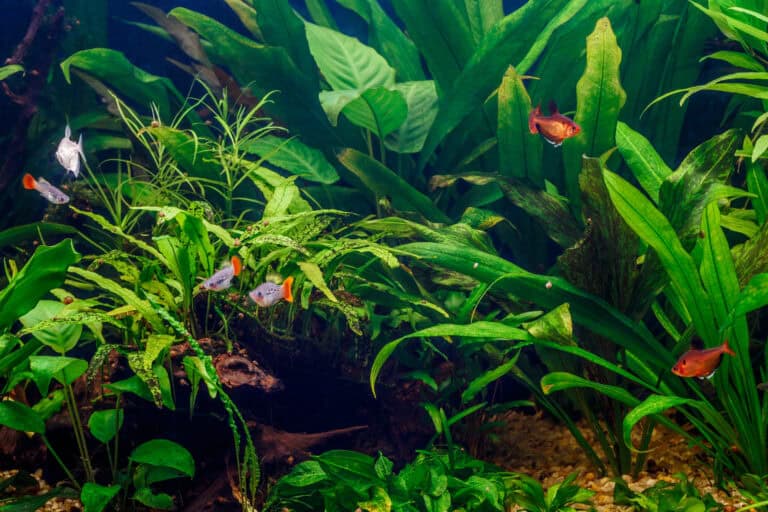

If you go to a fish store and ask for advice on schooling fish, they will tell you the same thing every time. You need to purchase at least six.
You will see this rule on forums, care tags, and other places as they treat this ‘rule’ like it is gospel truth. But there are reasons for it. Keeping schooling fish in groups of two or three causes great stress and ultimately leads to a shorter lifespan. Overgeneralizing this rule to every species is also not right.
When it comes to Harlequin Rasbora (Trigonostigma heteromorpha), six is actually the worst number you could have in your tank.
In my 15 years of experience in the aquarium hobby, I have kept many species of rasboras. I have observed them in small setups to large blackwater biotope systems. Harlequin Rasboras aren’t interchangeable tetras that just need a few friends to be secure. They have a social hierarchy. Buying exactly six of them, means you have unintentionally created a very high stress environment for the most subordinate fish in the group. blackwater biotopes
The Hierarchy Problem
To know how bad six is as a number, we need to look at the social dynamics of Harlequin Rasboras.
The fish have a clear pecking order. The males evaluate each other, fight over temporary territories, and try to impress the females. In a large school, this behavior is interesting to watch and the aggression is spread over many individuals.
This completely changes with a group of six.
Buying six juvenile Harlequins means you’re about two or three males. When they mature, the largest male will claim dominance. Due to the small group size, he has very few other fish to chase around. This is where the aggression gets concentrated. The dominant male won’t have enough distractions, and so he hyper-focuses on the same one or two subdominant fish.
The Target Fish Effect
In a school of six, the weakest fish becomes a target.
Unlike other subdominant fishes, this one will not be able to hide in the crowd… Because there are no crowds. Every time this fish tries to join another group to feed or swim, the dominant male chases it away. If you look closely, you’ll start to see particular signs of stress in this target fish.
- Hiding behavior: The fish will hover near the heater, hide behind the filter intake, or stay pinned near the substrate.
- Clamped fins: The dorsal and anal fins will be held tight against the body rather than standing proud.
- Color loss: The signature bright copper body will fade to a dull, washed-out silver, and the black pork chop marking will look gray.
The target fish will eventually stop eating and will become sick and die due to the harassment that compromises his immune system. After the target fish dies, the dominant male fish simply picks a new target fish From the remaining four fish, and the cycle continues.
Behavior Across Different School Sizes
To illustrate how numbers determine behavior, I’ve created a breakdown of what you can expect based on your school’s specific size.
| School Size | Social Dynamics | Stress Level |
|---|---|---|
| Under 6 | Fish feel highly exposed to predators. They will rarely school openly and will hide among plants. | Severe |
| Exactly 6 | Hierarchy forms, but aggression is too concentrated. The weakest fish is constantly bullied. | High for subdominant fish |
| 8 to 10 | Aggression begins to disperse. Targeted fish can retreat into the group and lose the dominant male’s attention. | Low |
| 15 plus | Natural behavior unlocks. Males spar harmlessly. The school moves as a confident, cohesive unit. | Minimal |
The Magic Numbers for Harlequin Rasboras
What would be the correct number if six is a mistake?
For this species, the age range of 8 to 10 years is the true minimum. At this age, the math finally works to the fish’s advantage. Should a dominant male decide to pursue a rival, that rival has the opportunity to dart to the center of the school. The dominant male becomes disoriented and cannot keep track of his target among the many similar copper bodies. The aggression is dispersed, and no individual fish has to suffer the bullying.
However, to observe this species in their natural habitat, you will need a group of 15 or more.

In a big school, the males use their energy showing off to each other instead of being aggressive. They will flare fins, color up, and swim in line to show domination. It is a cool show of behavior, but you will completely miss it if you only get a half dozen.
Harlequin Rasbora School Size Calculator
There is an easy tool that you can use to measure the volume and footprint of your tank in order to determine the ideal size of the school of Harlequins for your setup.
Tank Size and Stocking Reality
To increase the size of your school, you will need to offer the necessary physical space.
A 10-gallon tank is not big enough for ten Harlequin Rasboras. They like to swim a lot, so they need a tank that gives them enough space to swim, and they make a lot of vertical movements as they school. The bare minimum size tank that you could keep a proper group of eight to ten is a 20-gallon long.
Please note that I requested a 20-gallon long, not a 20-gallon high. Tall tanks are not suitable for schooling fish. Harlequins swim horizontally and not vertically. They require a 30-inch wide lane for horizontal swimming to expend energy and to regulate their social hierarchy.
Treating Fish as Individuals
Everyone loves rules on the internet (for example, telling a complete beginner to buy six of each fish species). But fish can’t read the internet.
Each species has unique requirements and social structures that we need to properly understand so that we can design aquariums that promote their natural activities. Instead of adhering to the standard rule of six, provide your Harlequin Rasboras with the appropriate numbers and they will give you years of health, activity and vibrancy.